
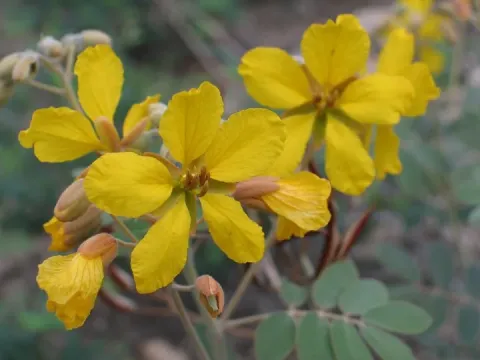
Slender-podded senna
Cassia leptocarpa
The sowing of Cassia leptocarpa requires well-warmed soil, ideally reaching temperatures of 18 degrees Celsius or higher to ensure robust seedling emergence and vigor.
What the section contains
Slender-podded senna
Seeds should be planted at a depth of 2 to 3 centimeters. Proper soil coverage is essential to maintain the moisture levels necessary for breaking seed dormancy and supporting early root development.
Row spacing is typically set between 45 and 60 centimeters, which allows for efficient mechanical weeding and ensures that each plant receives sufficient light and soil nutrients.
Scarification of seeds before planting is highly recommended to improve uniformity in germination, as the hard seed coat common in this family can otherwise lead to staggered emergence.
The timing of sowing should be aligned with the beginning of the rainy season to maximize the plant's natural ability to utilize stored soil moisture during its establishment phase.
This legume species thrives best in well-drained loamy soils. It is highly sensitive to waterlogging, so fields with excellent natural drainage are required to prevent root-related issues.
As a sun-loving plant, it requires full sun exposure to maximize photosynthetic efficiency, which directly correlates to the production of high-quality biomass or seed yield.
The plant exhibits significant drought tolerance once established, making it a viable agricultural candidate for regions where water resources are periodic or limited throughout the season.
Nitrogen fixation is a key benefit of this crop. When introduced to new fields, the application of appropriate rhizobial inoculants is necessary to promote the formation of root nodules.
Soil pH levels should ideally be near neutral, although the plant displays a moderate tolerance to slightly acidic conditions, allowing it to adapt to various tropical and subtropical soil profiles.
Fungal diseases, such as leaf spot and various blights, represent the most common threat to Cassia leptocarpa, particularly in humid climates with poor air circulation between rows.
Insect pests, including various beetle species and lepidopteran larvae, can cause substantial damage to both foliage and seed pods, requiring integrated pest management strategies.
Root rot pathogens become prevalent if the soil remains saturated for extended periods, leading to stunted plant growth and significant reductions in overall crop performance.
Crop rotation is an essential preventive measure to avoid the build-up of soil-borne diseases and pests that specifically target leguminous crops within the same field year after year.
Regular field scouting for early signs of infestation, such as discolored leaves or signs of insect feeding, allows for timely intervention using biological or chemical control methods.
Harvesting usually involves collecting the mature pods once they begin to change color, indicating that the seeds inside have reached their physiological maturity.
Mechanical harvesting is possible, but equipment must be calibrated to avoid excessive shattering of the pods, which could lead to significant seed losses during the collection process.
Post-harvest handling involves thorough drying of the seeds to ensure long-term storage viability and to prevent the development of mold and quality degradation.
In smaller operations, hand-harvesting is often employed to ensure higher seed purity and to select only the most mature plant material during the collection stage.
The harvested crop should be stored in cool, dry conditions with adequate ventilation to maintain the viability of the seed lot until it is ready for processing or subsequent sowing.