
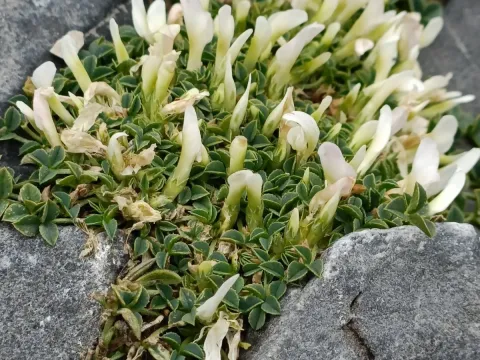
Single-flowered clover
Trifolium uniflorum
The single-flowered clover (Trifolium uniflorum) is a perennial herbaceous plant belonging to the Fabaceae family. As a specialized legume, it is well-adapted to Mediterranean environments, characterized by its low-growing habit and resilience in harsh, rocky terrains.
What the section contains
Single-flowered clover
The native range of this species spans the Mediterranean region, where it thrives in open, sunny habitats. Its evolutionary adaptations allow it to survive in nutrient-poor, stony soils where it forms a critical component of local ecosystems and biodiversity.
Botanically, the plant is distinguished by its unique flower morphology, where single blooms appear rather than the typical dense inflorescences found in other clover species. The leaves are trifoliate, typical of the genus, providing high-quality forage for grazing livestock.
Regarding cultivation requirements, this crop favors well-drained, neutral to slightly alkaline soils. It is particularly sensitive to waterlogging, making proper land preparation and site selection critical for maximizing the biomass yield of the clover in an agricultural setting.
The agronomic importance of Trifolium uniflorum lies in its soil-enriching properties. By fixing atmospheric nitrogen, it improves soil fertility and enhances the structure of degraded land, serving as an effective plant for sustainable pasture management and soil conservation programs.
The primary pathological threats to the crop include various root rot pathogens triggered by poor drainage. Implementing a rotation strategy and ensuring optimal soil aeration are the most effective management practices to mitigate these fungal risks.
Insect pests, such as clover weevils and aphids, represent a constant threat to stand longevity. Integrated pest management, including regular scouting and biological control measures, is necessary to protect the leaf tissue and reproductive structures from significant economic damage.