
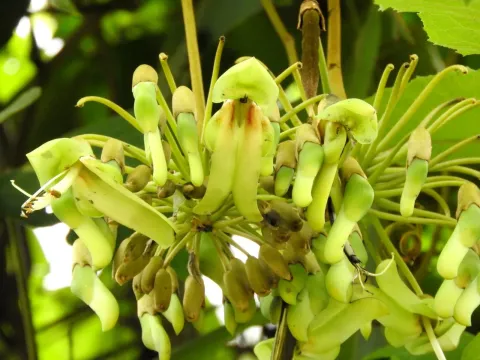
Silver-leaf velvet bean
Mucuna argyrophylla
Mucuna argyrophylla is a robust perennial vine from the Fabaceae family that is widely cultivated as an annual crop in tropical farming systems. Native to South America, this plant is recognized for its ability to produce significant biomass rapidly, making it an excellent candidate for soil restoration.
What the section contains
Silver-leaf velvet bean
Sowing typically takes place at the onset of the rainy season. The seeds require well-drained, fertile, or even moderately depleted soil to establish themselves. Proper planting depth is crucial, usually between 3 to 5 centimeters, to protect the seed from excessive soil temperature and moisture loss during the early stages.
Optimal germination occurs at temperatures between 22 and 28 degrees Celsius. Once the seeds germinate, the plant displays aggressive early growth, allowing it to suppress weeds effectively within the first few weeks of development by forming a dense vegetative canopy.
Farmers often sow the crop in rows with spacing of 50–70 centimeters. This density is sufficient to cover the ground completely, thereby reducing evaporation and protecting the soil surface from the damaging effects of heavy tropical rainfall and direct sunlight.
As a legume, it naturally fixes atmospheric nitrogen. No chemical nitrogen fertilizers are usually required, provided that the soil conditions allow for the formation of effective root nodules, which can be enhanced by the presence of specific soil bacteria.
This species is highly heat-dependent and strictly requires a frost-free environment to flourish. It thrives best in tropical and subtropical regions where it can utilize long daylight hours and high humidity for rapid biomass accumulation.
While Mucuna argyrophylla is somewhat tolerant to diverse soil types, including acidic and low-fertility soils, it performs best in deep, well-structured loam. Drainage is a critical requirement, as waterlogged conditions can lead to root diseases and stunted growth.
The plant is known for its moderate drought tolerance, enabled by a deep taproot system. However, for maximum productivity, consistent moisture during the vegetative phase is essential. It is not suitable for regions with prolonged, severe arid conditions.
Light availability is a major factor in its growth cycle. The plant is photophilic and does not compete well in deeply shaded environments. It should be planted in open fields to ensure the maximum photosynthetic output required for its nitrogen-fixing activities.
Soil management plays a vital role in its utility. It acts as an excellent soil builder by increasing the organic matter content when incorporated into the field, improving the physical structure and fertility of exhausted tropical soils.
The primary yield from this crop is its substantial green mass. Under favorable growing conditions, it can produce 30 to 50 tonnes of biomass per hectare. This organic matter is essential for sustaining the long-term fertility of the agricultural ecosystem.
The nitrogen-fixing capacity of the crop represents a significant economic yield. By integrating it into a crop rotation, farmers can reduce their reliance on expensive synthetic nitrogen fertilizers, thereby lowering production costs for subsequent main crops.
In terms of forage production, the seeds provide a source of high protein. However, their use is limited by anti-nutritional factors. Consequently, proper processing methods, such as boiling or roasting, are mandatory to ensure the safety of animal feed.
The cover crop effect provides indirect yield benefits. By keeping the soil cool and moist, Mucuna argyrophylla creates a favorable micro-environment for soil organisms, which in turn leads to better nutrient cycling and increased crop success in the long run.
Overall, the plant serves as a "living fertilizer" that bridges the gap between agricultural cycles, offering a sustainable solution for smallholder and commercial farmers alike who seek to maintain soil quality in challenging climates.
Fungal diseases are the most prominent threats, particularly during periods of high humidity and poor airflow. Leaf spot and anthracnose are common issues that can lead to rapid foliage decline if the planting density is too high or if drainage is insufficient.
Various insect pests, including leaf-eating beetles and caterpillars, can damage the foliage. Integrated pest management strategies, such as biological control and periodic field monitoring, are essential to keep populations below economic damage thresholds.
Nematodes, which attack the root system, pose a long-term threat if the crop is continuously planted on the same land. Rotating the crop with non-leguminous species is a fundamental practice to break the life cycle of these persistent soil pathogens.
Parasitic plants like Striga can also infest fields, especially in areas where these parasites are endemic. Preventive measures include thorough site preparation and the use of clean, certified seeds to avoid introducing pathogens into new areas.
Maintaining soil health through proper drainage and avoiding excessive nitrogen runoff can mitigate many of these threats. Healthy plants with robust root systems are significantly more resilient to pest and disease pressure.
Harvesting for green manure is typically performed during the flowering stage, just before seed pods begin to dry out. At this stage, the plant has achieved its peak nutritional value, making it perfect for incorporation into the topsoil.
When harvesting for seeds, the timing is delicate. Pods should be collected when they have turned brown and dry, but before they open naturally. This often requires multiple manual passes over the field to ensure that no seeds are lost to the soil.
Workers should take precautions when handling the plant, as the silver-leaf pubescence can cause mild skin irritation. Using gloves and long-sleeved clothing is standard procedure to ensure safety during manual harvesting or weeding operations.
Post-harvest drying is critical to prevent mold. Seeds should be spread out in thin layers in a dry, ventilated area until their moisture content drops to a safe level for long-term storage, typically under 14 percent.
Proper storage in rodent-proof and insect-proof containers ensures that the seed bank remains viable for the next planting season. Quality control during harvest directly influences the germination rate of the future crop, ensuring efficient and productive agricultural cycles.