
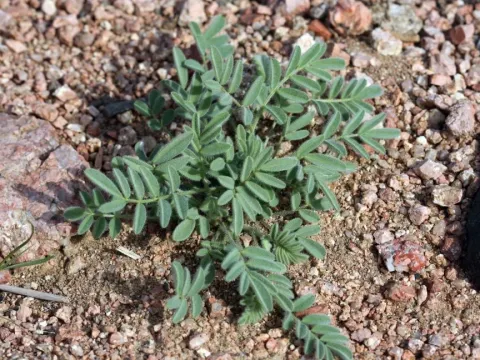
Astragalus eremophilus
Astragalus eremophilus
Astragalus eremophilus is a perennial legume belonging to the Fabaceae family, specifically adapted to survive in harsh arid and semi-arid environments.
What the section contains
Astragalus eremophilus
Native to the desert regions of Central Asia, this species has developed specialized morphological traits to withstand extreme water scarcity and heat.
The plant exhibits a robust taproot system, which is essential for tapping into deep moisture sources in sandy or rocky substrates.
In agriculture, it is primarily valued as a reclamation species used to stabilize desert soils and prevent wind erosion in vulnerable landscapes.
Additionally, it serves as a valuable forage resource for livestock, particularly in regions where other forage crops fail to thrive due to drought.
The species thrives in well-drained sandy or sandy-loam soils that prevent waterlogging, which is detrimental to its physiological health.
High levels of solar radiation are required for optimal growth, as the plant is a dedicated heliophyte adapted to open desert environments.
Astragalus eremophilus shows remarkable tolerance to soil salinity, allowing it to grow in areas unsuitable for most other agricultural crops.
It is perfectly acclimated to extreme temperature fluctuations between day and night, a common feature of the desert climate it inhabits.
While minimal irrigation can boost biomass production, the plant is evolutionarily engineered to survive on minimal precipitation patterns.
Fungal diseases, including various rusts and mildews, represent the most significant threat during periods of unexpected humidity or poor drainage.
Insect pests such as weevils and grasshoppers can cause severe damage by consuming leaf tissue or targeting the developing reproductive structures.
Root rot pathogens may become prevalent if the soil structure remains saturated for an extended duration, leading to plant mortality.
Seed-eating insects are a major concern for commercial seed production, as they can significantly reduce the viability and quantity of the yield.
Effective management strategies include crop rotation, monitoring for pest outbreaks, and avoiding irrigation practices that foster fungal growth.