
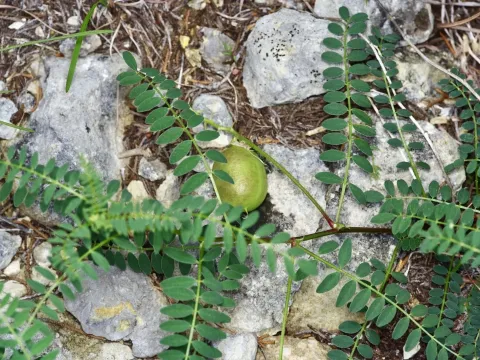
Groundplum milkvetch
Astragalus crassicarpus
Groundplum milkvetch (Astragalus crassicarpus), a member of the Fabaceae family, is a perennial legume that requires careful seed preparation. The seeds possess a hard coat, necessitating scarification to break dormancy and ensure uniform germination.
What the section contains
Groundplum milkvetch
The optimal sowing time is early spring, once the soil has sufficiently warmed up and can be properly tilled. Maintaining adequate soil moisture during the emergence phase is critical for establishing a healthy, vigorous crop.
Seeds should be planted at a depth of 2 to 3 centimeters. This depth provides enough protection against drying out while allowing the seedling to emerge efficiently. Proper contact between the seed and the soil is essential, which is best achieved through post-sowing compaction.
For forage production, sowing in rows with spacing of about 15-20 centimeters is common. This spacing helps the crop establish a dense stand that can outcompete weeds during the initial slow growth phase.
Ensuring that the seedbed is free from perennial weeds before planting is a crucial agronomic step, as the legume's early growth is often slower than that of invasive grasses, which could otherwise choke out the young plants.
Astragalus crassicarpus thrives in well-drained soils and is highly sensitive to waterlogging. It performs best on loam, sandy loam, or fertile chernozem soils where aeration is sufficient to support root development.
This species is exceptionally drought-tolerant and winter-hardy, making it a valuable candidate for regions with semi-arid climates. It utilizes available moisture efficiently and survives harsh temperature fluctuations common in the Great Plains.
The plant prefers neutral to slightly alkaline soil conditions. If the soil is too acidic, liming is required to improve the environment for the nitrogen-fixing bacteria that form a symbiotic relationship within the plant's root nodules.
Phosphorus and potassium fertilizers are often recommended to boost root health and enhance winter survival. Nitrogen fertilization is rarely necessary, as the plant fulfills its nitrogen needs through atmospheric nitrogen fixation.
Exposure to full sunlight is vital for optimal development. As a long-day plant, it requires intense light for energy synthesis and successful completion of its reproductive cycle, leading to vigorous flowering and seed set.
The forage yield of groundplum milkvetch varies based on site productivity but can range from 15 to 25 tons of green mass per hectare under ideal conditions. Its nutritional profile, high in protein and amino acids, makes it a premium forage source.
The crop is highly palatable to various livestock and is suitable for hay production, haylage, or as part of a grazing rotation. Its ability to regrow rapidly after mowing or heavy grazing adds to its economic value.
Seed yield is generally in the range of 200–400 kilograms per hectare. Successful seed production requires careful management of pollinator activity and protection against pod-eating insects during the critical flowering phase.
To maximize forage quality, the crop should be harvested during the flowering initiation stage. At this point, the ratio of protein to fiber is optimal, ensuring high digestibility and livestock performance.
Productivity tends to peak between the third and fifth years of establishment. Implementing occasional fertilization or oversowing in older stands helps maintain high yields and ensures the persistence of the stand over time.
The primary pests affecting groundplum milkvetch include species of weevils that damage developing seeds. Effective control involves monitoring infestation levels and applying integrated pest management strategies.
Fungal diseases, such as powdery mildew or rusts, may occur during periods of high humidity or poor ventilation. Maintaining a healthy plant stand through proper site selection is the best preventative measure against these infections.
Root rot and crown diseases are more prevalent in heavy or poorly drained soils. The agronomic focus should remain on maintaining soil drainage to prevent the development of conditions conducive to fungal growth.
Pest management practices should prioritize the safety of beneficial insects. Since Astragalus species depend on cross-pollination, minimizing insecticide impact during the blooming period is vital for securing a reliable seed harvest.
- Crop rotation with non-leguminous plants to break disease cycles.
- Regular field scouting to detect early signs of pest pressure.
- Selecting drought-resilient varieties to mitigate seasonal environmental stress.
Hay harvesting is most efficient when using equipment that allows for quick cutting and conditioning. Rapid field drying is essential to preserve the nutritional value, particularly vitamins and protein, in the harvested biomass.
A moderate stubble height (5-7 cm) should be left after mowing to protect the crown of the plant. This promotes healthy regrowth and prevents damage to the nodes that generate the next cutting's foliage.
For seed production, a two-phase harvesting method is standard. The crop is cut and windrowed when the majority of pods turn brown, followed by threshing once the moisture content has dropped to safe levels.
Post-harvest cleaning and drying are critical. Seeds should be dried until they reach a moisture level of approximately 12-14 percent, which ensures stability and longevity during long-term storage in cool, dry facilities.
After the harvest, residue management is important. If the area is used for grazing, livestock can clean up the remaining stubble, providing an additional economic benefit while helping to incorporate organic matter into the soil.