
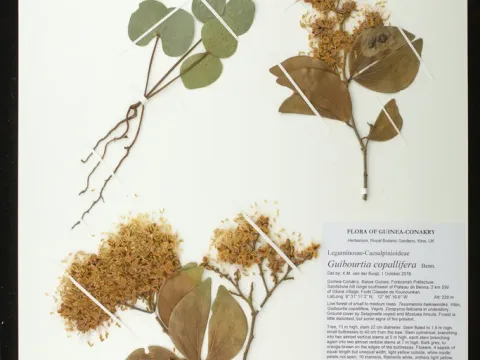
Guibourtia copallifera
Guibourtia copallifera
Guibourtia copallifera belongs to the Fabaceae family. It is a robust tropical tree native to the forests of West Africa, where it plays a significant ecological role within its natural habitat.
What the section contains
Guibourtia copallifera
The species requires a humid tropical climate to thrive. High and stable temperatures throughout the year are essential for the plant's development, as it is highly sensitive to frost and cold stress.
Regarding soil preferences, this tree performs best in deep, well-drained soils. While it can survive on various soil types, fertile loams provide the optimal nutrient profile for long-term growth and resin production.
Water management is critical for the health of the tree. While it requires a significant amount of rainfall, it must not be planted in areas prone to waterlogging, as the roots require adequate oxygenation.
Botanically, it is recognized for its slow-growing nature and resilient wood structure. The tree creates a closed canopy in its native forests, which protects the soil surface and maintains local microclimates.
The primary economic value of the tree lies in the production of copal resin. This natural product is harvested from the bark and is highly valued in the production of specialized varnishes and coatings.
Timber utilization is another major aspect. The wood of Guibourtia copallifera is dense and durable, making it suitable for high-quality furniture, flooring, and various industrial construction applications.
Harvesting techniques involve careful tapping of the trunk to collect the resin without compromising the long-term vitality of the tree. Sustainable tapping methods are essential to ensure the tree remains productive for many years.
For timber, forestry management plans prioritize selective logging. This approach ensures that older trees are removed while allowing younger saplings to reach maturity, maintaining forest density and health.
Ongoing research focuses on maximizing the yield of both resin and wood through improved silvicultural practices, which help balance economic output with environmental conservation in its native regions.