
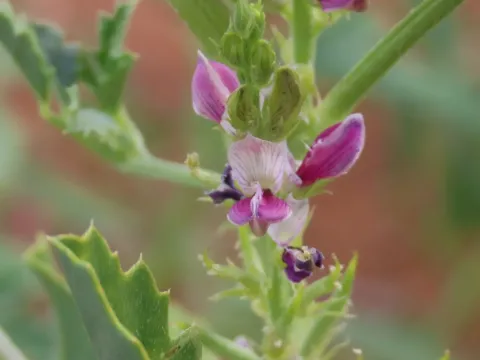
Guar
Cyamopsis
Guar (Cyamopsis tetragonoloba) is a warm-season crop that requires soil temperatures of at least 18–20 °C to ensure successful seed germination and initial establishment.
What the section contains

Guar
The optimal sowing time is after the danger of spring frost has passed, usually late spring to early summer, when stable warm weather conditions prevail.
Planting is typically performed in wide rows, with spacing between 45 and 60 cm, which facilitates efficient mechanical inter-row cultivation for weed management.
The seeding rate varies based on regional soil types, generally ranging from 15 to 20 kg per hectare to achieve an ideal plant population density.
Seed depth is critical; it should be planted at a shallow depth of 3 to 5 cm to promote quick and uniform emergence, especially in soil with adequate moisture levels.
As a member of the Fabaceae family, guar is recognized for its exceptional drought tolerance, allowing it to thrive in arid regions where other crops struggle.
It performs best in alluvial, sandy, and sandy-loam soils with good drainage, though it shows high adaptability to various soil profiles, excluding waterlogged areas.
Guar exhibits a strong ability for nitrogen fixation, which significantly improves soil fertility, making it an excellent rotational crop for sustainable agriculture.
The ideal temperature range for active growth is 25 to 35 °C; the crop is sensitive to cold temperatures and high air humidity, which can hinder its normal development.
Abundant sunlight is essential for guar throughout its growth cycle; insufficient light intensity leads to stunted vegetative growth and reduced seed yield potential.
The yield of guar is heavily influenced by climate conditions, irrigation schedules during the flowering phase, and the inherent fertility of the agricultural land.
Under good management practices, dry seed yields typically range from 1,000 to 2,000 kg per hectare, depending on local rainfall or irrigation availability.
The primary industrial value lies in the guar gum content found in the endosperm of the seeds, which accounts for approximately 30% of the seed mass.
Beyond seed production, the green biomass serves as a high-protein forage crop for livestock, making the plant useful in mixed farming systems.
Market demand for natural hydrocolloids drives the adoption of intensive farming techniques, aiming to maximize the yield of high-quality gum-producing seeds.
Guar is susceptible to various fungal pathogens, including anthracnose, fusarium wilt, and powdery mildew, which thrive in humid or poorly ventilated conditions.
Bacterial leaf spot is a significant concern that can reduce the overall quality of harvested seeds and cause premature lodging of the plant during maturation.
Pest management focuses primarily on aphids, which attack young stems and developing pods, sucking plant juices and reducing the overall vigor of the crop.
Various species of noctuid caterpillars can cause significant damage by defoliating the plant, thereby reducing its photosynthetic capability and final output.
Integrated pest management, including systematic crop rotation and the use of resistant varieties, is highly recommended to minimize reliance on synthetic pesticides.
The harvest phase begins when pods turn brown and the seeds reach their maximum hardness, typically containing a moisture content of 12–14% for storage.
Standard combine harvesters are utilized for large-scale operations, requiring careful adjustment to prevent seed breakage and minimize harvest losses.
Timely harvest is essential to prevent pod shattering, as delayed operations in the field can result in significant yield loss due to seed dispersal.
Post-harvest processing involves thorough cleaning to remove organic debris and drying the seeds to reach standard storage moisture to prevent microbial degradation.
By-products such as hulls and straw, generated during processing, are valuable, often repurposed as organic amendments or supplemental feed components for cattle.