
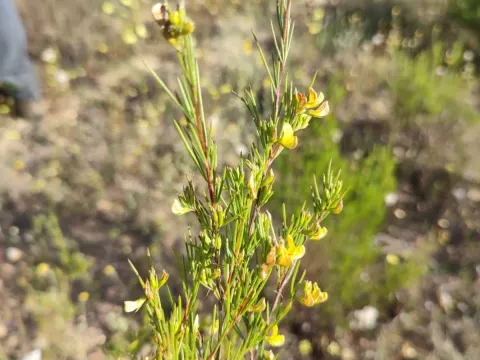
Rooibos
Aspalathus linearis
Rooibos seeds are sown in nurseries during late summer or early autumn, typically between February and March in the Southern Hemisphere. To enhance germination, seeds undergo scarification or heat treatment, mimicking the natural conditions following seasonal wildfires.
What the section contains
Rooibos
Seedlings are raised in specialized containers until they reach a height of approximately 10-15 centimeters. This process lasts between 6 and 8 months, after which the young plants are ready for transplanting into open fields.
Field planting is carried out at the onset of the rainy season, which is crucial for the successful establishment of the young shrubs. Planting density varies depending on soil type, typically ranging from 10,000 to 15,000 plants per hectare.
Rooibos is a perennial shrub belonging to the Fabaceae family that requires a significant adaptation period to open field conditions. Careful selection of planting time minimizes the risk of seedling loss due to drought.
Adherence to crop rotation is mandatory to prevent soil nutrient depletion and the accumulation of pathogens. After 4-5 years of exploitation, the land is usually left fallow or planted with other crops to restore balance.
Rooibos grows exclusively in the Cederberg region of South Africa, where a specific microclimate prevails. The crop thrives in deep, sandy, acidic soils that are generally low in available nutrients.
The plant is highly sensitive to humidity levels and temperature fluctuations. It requires a Mediterranean climate with hot, dry summers and cool, wet winters, which allows the roots to penetrate deeply into the soil in search of moisture.
Soils for successful rooibos production must have excellent aeration and drainage properties. Heavy clay soils are unsuitable, as they lead to root rot and waterlogging, which are fatal to the plant.
For healthy development, Aspalathus linearis requires a symbiotic relationship with specific soil bacteria that fix nitrogen. In artificial or farmed conditions, these are often supplemented into the soil if absent.
The crop is highly light-demanding and cannot tolerate shade. Excessive fertilizer application is detrimental to rooibos, as it is evolutionary adapted to extremely nutrient-poor soils with minimal phosphorus and nitrogen availability.
The first commercial harvest can be gathered only 18 months after transplanting the seedlings. The bush reaches full productivity by the third year of vegetation.
Yield depends heavily on the age of the plantation, annual rainfall intensity, and management practices. On average, one hectare can produce between 500 and 1000 kilograms of final dry product.
Harvesting is performed either mechanically or by hand. After primary processing, the stems and leaves are bruised and crushed, a step that directly impacts the final quality and chemical output of the raw material.
Collection efficiency declines by the fifth or sixth year of the plant's life, after which the plantation is cleared for replanting. Economic returns are strongly correlated with the quality of the subsequent fermentation process.
Global demand for rooibos is consistently increasing, compelling farmers to optimize agrotechnical maps to maximize the yield of high-quality tea leaves per unit of land area.
The primary threat to rooibos is fungal root disease, often triggered by excessive soil moisture and water accumulation in the soil profile. Affected plants show rapid yellowing and eventual death.
Nematodes are serious pests that damage the root system, hindering the plant's ability to absorb water and nutrients. This becomes particularly problematic if crop rotation rules are ignored over several years.
Insect pests, such as weevils and various species of caterpillars, can cause significant damage to the plant's green mass. Regular monitoring of the plantation during spring and summer is essential to prevent large-scale losses.
Weed competition poses a severe challenge, especially during the early stages of plant life. Regular weeding and mulching are necessary to reduce environmental stress on young bushes.
Extreme weather events, such as severe droughts or atypical heavy summer rains, serve as critical stressors that frequently trigger disease outbreaks within the plantation.
Harvesting of rooibos is conducted during the summer months when the essential oil content in the leaves reaches its peak. At this stage, the plant is in an active growth phase but has already accumulated sufficient biomass.
The harvest is carried out by cutting the branches at a height of approximately 30-40 centimeters from the ground. This allows the plant to regenerate and provide a secondary yield in the following season.
Immediately after harvest, the raw material undergoes mechanical bruising, after which it is moistened to trigger the fermentation process. It is during this stage that rooibos develops its characteristic reddish-brown color and distinct aroma.
Fermentation takes place outdoors or in specialized curing sheds where temperature and humidity are strictly controlled. The process is concluded with rapid sun-drying to halt oxidation.
Once dried, the final product undergoes cleaning, grading by particle size, and steam sterilization to ensure the safety and premium quality of the beverage for the end consumer.