
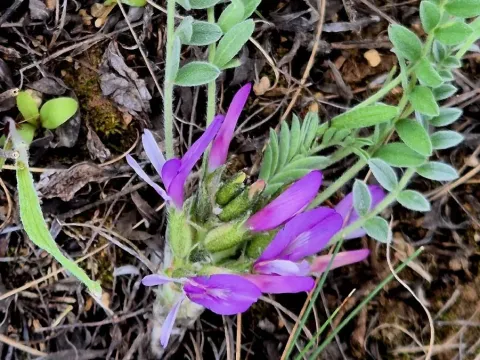
Rock milkvetch
Astragalus rupifragus
Rock milkvetch is a perennial legume recognized for its resilience and adaptability. Sowing is typically performed in early spring, once the soil has warmed sufficiently to ensure stable germination rates.
What the section contains
Rock milkvetch
The seeds should be planted at a depth of 2-3 cm using standard row spacing. Because the seed coat can be quite tough, scarification is often recommended to improve the rate of emergence in the field.
Due to the plant's relatively slow initial growth, weed control during the establishment phase in the first year is critical. Ensuring a clean field allows the root system to develop without resource competition.
The seeding rate must be adjusted based on the specific local environment and soil type. Wide-row spacing is often preferred to promote healthy development and structural integrity of the mature plants.
Inoculation of seeds with appropriate rhizobial strains is essential when establishing the crop on land where it has not been previously grown to maximize the plant's nitrogen-fixing capabilities.
The plant thrives in rocky, calcareous, and well-drained soils, reflecting its natural habitat. It is highly intolerant of waterlogging and prefers environments with excellent soil aeration.
As a light-loving species, it performs best in open, sunny fields. It displays remarkable drought tolerance, making it an ideal candidate for cultivation in arid or semi-arid climatic conditions.
Rock milkvetch responds positively to phosphorous and potassium fertilizers, which support long-term vigor and root development. Excessive nitrogen fertilization is generally unnecessary and may be counterproductive.
The species exhibits excellent winter hardiness, allowing it to survive extreme temperatures typical of its native mountainous or steppe origins. It is not significantly affected by late spring frosts.
Maintaining soil pH in the neutral to slightly alkaline range is optimal for this species. Its natural affinity for limestone-based soils makes it particularly suitable for degraded or marginal lands.
Rock milkvetch reaches its peak biomass production by the third year of growth. It is highly valued for the high protein content of its green forage, which improves overall livestock nutrition.
Depending on seasonal rainfall and management, the crop can support multiple cuts per year. This consistency makes it a reliable component in the feed management strategy for modern farms.
Seed production is stable and reliable under dry summer conditions. Harvesting at the correct physiological stage ensures a sustainable supply of seeds for subsequent planting seasons.
When used in mixed stands with perennial grasses, rock milkvetch significantly improves the total yield and quality of the hay. Its deep rooting helps in stabilizing the soil structure simultaneously.
Total annual yield is determined by the stand density and the availability of essential soil nutrients. With proper management, the longevity of the stand remains high for many years.
The primary threats include fungal diseases such as powdery mildew and rust, which are most prevalent in humid, stagnant conditions. Proper stand management and spacing help mitigate these risks.
Insect pests, such as weevils, can target both the young sprouts and the developing seeds within the pods. Monitoring populations is necessary to prevent significant yield losses during peak growth.
Damage to the root system by soil-dwelling insects is a potential issue in some regions. Maintaining healthy soil biology helps keep pest numbers below the economic threshold level.
Integrated pest management, including crop rotation and the use of natural enemies, is the preferred strategy for maintaining crop health without relying heavily on chemical pesticides.
Cultural practices that promote airflow throughout the canopy reduce the development of humidity-driven pathogens, thereby increasing the health and longevity of the stand.
Harvesting for green forage should occur at the early flowering stage to capture the highest nutritional value. This timing also facilitates quicker regeneration of the plants for subsequent regrowth.
Hay production requires careful mechanical harvesting and rapid drying in windrows to preserve the quality of the biomass. The plant's structure allows for efficient drying under warm conditions.
For seed production, harvesting is timed to coincide with the browning of the majority of the pods. Care must be taken to minimize shattering losses during the cutting and gathering process.
Early morning harvests are recommended to take advantage of higher humidity levels, which help keep the pods intact until the seeds are processed within the harvester.
Following the harvest, seeds should be cleaned, dried to a moisture content of 12-14%, and stored in a cool, dry place to maintain maximum germination potential for future seasons.