
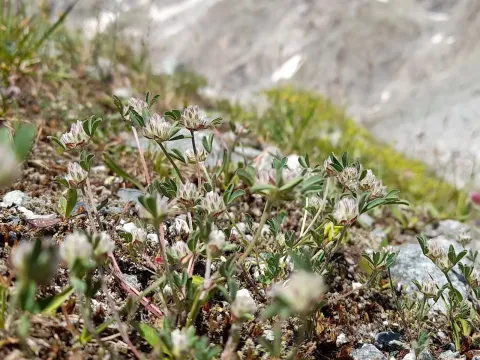
Rock clover
Trifolium saxatile
Sowing of Trifolium saxatile is best performed in early spring when the soil retains sufficient moisture. This timing is critical for the germination of its small seeds, which require consistent humidity during the initial establishment phase.
What the section contains
Rock clover
The seeds should be sown at a shallow depth of approximately 1 to 2 centimeters. Because they contain limited energy reserves, deep planting often results in poor seedling emergence and weak plant development.
Using a nurse crop, such as a thin stand of cereals, can provide essential protection for young rock clover plants against direct sunlight and wind. This method is highly recommended in open fields with dry climates.
Soil compaction through rolling before and after seeding is vital. This process ensures that the seeds have optimal contact with soil particles, facilitating efficient water uptake during the crucial germination period.
In regions with mild winters, autumn sowing is also a viable option, provided it is timed before the ground freezes. This allows the seeds to benefit from early spring moisture immediately upon the first thaw.
Rock clover belongs to the Fabaceae family and is naturally adapted to rocky, calcareous mountain slopes. Its biological structure reflects a high tolerance for skeletal, mineral-rich, and well-drained soil types.
The plant thrives in sites with excellent drainage. Waterlogging is detrimental to its growth, as it leads to root asphyxiation and interferes with the symbiotic relationship with nitrogen-fixing rhizobia bacteria.
As a heliophyte, this species requires full sun exposure to maintain optimal vigor. It performs poorly in shaded areas, where competition from other vegetation significantly suppresses its growth and nitrogen-fixing efficiency.
The ideal soil pH for rock clover is neutral to slightly alkaline. Acidic soils must be amended with lime to ensure the proper activity of the root nodules and the overall health of the crop.
This species is exceptionally cold-hardy, a trait inherited from its natural habitat in high-altitude European regions. It is well-suited for temperate climates that experience significant seasonal temperature variations.
Common fungal diseases, particularly leaf spots and anthracnose, pose a significant risk during periods of high humidity. Proper field sanitation and avoiding excessive nitrogen fertilization help reduce disease pressure.
Root rot, often caused by soil-borne pathogens in poorly drained areas, remains a primary threat to the longevity of the stand. Implementing a structured crop rotation is essential for disease management.
Insects like clover weevils can cause substantial damage to both foliage and flowers. If left unchecked, these pests can drastically reduce both biomass productivity and potential seed harvest.
Nematodes are another potential biological threat, particularly in soils where host plants are grown consecutively. Their presence can severely hamper nutrient uptake and overall plant development.
A comprehensive approach to crop protection, including biological control methods and monitoring for pest outbreaks, is necessary to ensure the long-term success of the cultivation of this species.