
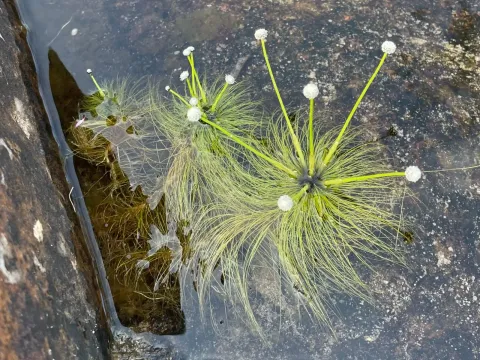
Eriocaulon equisetoides
Eriocaulon equisetoides
Eriocaulon equisetoides is a distinct member of the Eriocaulaceae family, highly valued in the hobbyist community for its unique, needle-like foliage. Originating from tropical and subtropical marshy habitats in Asia, it thrives in environments characterized by high humidity and consistent moisture.
What the section contains
Eriocaulon equisetoides
The plant grows in a compact rosette form, featuring rigid, linear leaves that resemble the structure of horsetails. This botanical architecture makes it a centerpiece specimen in planted tanks, provided the substrate is rich in nutrients and maintains a slightly acidic chemical profile.
Successful cultivation requires high-intensity lighting, as the plant is demanding in terms of light saturation. Without adequate light, the plant will struggle to maintain its compact growth habit and may exhibit signs of chlorosis or stunted development over time.
Water parameters must be carefully monitored, with soft water and a pH ranging between 6.0 and 6.8 being the standard for healthy growth. Continuous carbon dioxide (CO2) supplementation is essential to ensure the plant has enough inorganic carbon for photosynthesis.
Regarding maintenance, regular fertilization of the root zone is necessary because the plant relies significantly on its root system for nutrient uptake. Given its slow growth rate, a consistent but controlled nutrient regimen is preferable to avoid overwhelming the water column with excess minerals.
The primary threat to this species is the competition from filamentous algae, which can easily overtake the slow-growing rosette if nutrient levels in the water column are too high. Regular cleaning and proper algae control are vital to prevent the foliage from being smothered.
Root system health is another critical aspect; if the substrate becomes anaerobic, the plant is susceptible to root decay. This manifests as yellowing of the outer leaves and softening of the base, eventually leading to the collapse of the plant if the substrate is not refreshed.