
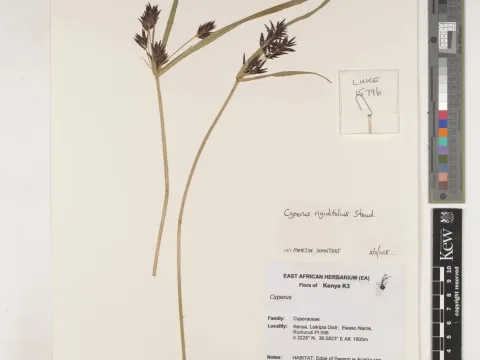
Rigid-leaved sedge
Cyperus rigidifolius
Rigid-leaved sedge (Cyperus rigidifolius) is a perennial herbaceous plant belonging to the Cyperaceae family. Unlike many other species of sedge that are considered persistent weeds, this specific species is of interest as a promising forage and industrial crop in tropical and subtropical regions.
What the section contains
Rigid-leaved sedge
The native range of this species includes parts of Central and Southern Africa, where the plant adapted to specific moisture regimes. Its cultivation is limited to areas with moderately hot climates, as the plant is highly sensitive to freezing temperatures and soil frost.
The plant prefers well-drained sandy or light loamy soils with a neutral or slightly acidic pH level. In its natural environment, Cyperus rigidifolius is often found on riverbanks or in areas prone to periodic flooding, indicating high moisture requirements.
Optimal development of the crop requires high levels of solar radiation and stable temperatures between 20 and 30 degrees Celsius. Lack of light or sudden temperature fluctuations lead to reduced growth rates and a decrease in overall plant biomass.
Agrotechnical measures include maintaining constant soil moisture levels, which is critical during the early growth phases. In industrial settings, drip irrigation systems are commonly used to minimize water consumption and eliminate the risk of waterlogging.
Sowing of Cyperus rigidifolius is primarily carried out in the spring when soil temperatures reach 15-18 degrees Celsius. The optimal method involves transplanting seedlings or rhizome division, which ensures a faster establishment compared to direct seed sowing.
Seed sowing rates require strict control, as seedlings are slow to establish in the initial phase. When using seeds, it is recommended to use protective covers or films to maintain a favorable microclimate in the root zone.
Deep plowing and the incorporation of organic fertilizers are essential steps in soil preparation, as the plant actively consumes mineral nutrients from the topsoil. High nitrogen content in the soil promotes vigorous vegetative growth.
When using rhizomes, planting is done in rows with a spacing of 45-60 centimeters. This provides sufficient space for the development of a robust root system and facilitates subsequent field management.
Post-sowing field care requires regular inter-row cultivation to prevent soil crusting. Controlling weeds during the first two months of growth is a mandatory requirement for achieving high yield potential.
The yield of Cyperus rigidifolius depends directly on fertilization intensity and water availability. With proper agrotechnical practices, the crop can provide multiple harvests during a single growing season.
Agricultural use includes harvesting green biomass for livestock feed and extracting fiber from the stems. The plant is valued for its resistance to siltation and its ability to quickly recover its aerial parts after mechanical harvesting.
In industrial plantations under intensive cultivation technologies, a stable dry matter output can be expected. Feed quality is determined by the harvest stage: biomass harvested before mass flowering is considered the most nutritious.
Additionally, the plant is used for phytoremediation, as its root system effectively absorbs excess nutrients from wastewater. This allows the crop to be grown on sites requiring biological treatment.
When evaluating economic efficiency, irrigation and harvesting costs are considered, which are offset by the longevity of the crop. Plantations can remain productive for 5-7 years without a significant decline in yields.
The primary threats to Cyperus rigidifolius are fungal diseases that develop under high air humidity and poor ventilation. Common issues include rust and leaf spot, which require the application of appropriate fungicides.
The most significant pests are lepidopteran larvae and soil nematodes, which damage the rhizomes. Management strategies include crop rotation and the use of biological control agents.
Monocultural planting carries a high risk of pathogen buildup in the soil. It is recommended to rotate the crop with cover crops to improve soil health and maintain microbiological balance in the root zone.
Mechanical damage to the root system during cultivation can provide entry points for infections. Therefore, agronomists recommend performing field work with extreme care to avoid damaging the tillering nodes.
Monitoring crop health should be conducted weekly, especially during periods of high humidity. Early detection of disease symptoms allows for the localization of infection spots without the need for large-scale chemical applications.
Harvesting green biomass is done mechanically using forage harvesters. An optimal cutting height of 5-7 centimeters is recommended to promote rapid regrowth from dormant buds on the rhizome.
For fiber production, harvesting is performed at a later stage when stems become coarser. After cutting, the biomass is naturally air-dried or dried in specialized chambers to a moisture content of 12-14 percent.
Harvest scheduling is planned so that the final cutting occurs no later than one month before the first frost. This allows the plant to accumulate sufficient energy reserves in its roots for successful overwintering.
Post-harvest processing involves cleaning raw material of debris and sorting by stem length if intended for industrial use. Storing dry material in well-ventilated areas is necessary to prevent spontaneous heating and mold development.
It is important to remember that timely harvesting prevents seed shattering if the plantation is not intended for seed production. Regular field cleaning of plant residues minimizes disease risks in the following season.