
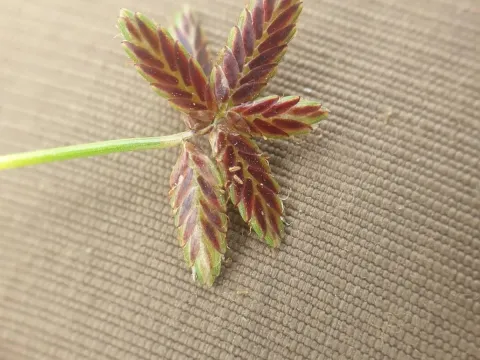
Shining flatsedge
Cyperus bipartitus
Shining flatsedge (Cyperus bipartitus) is a member of the Cyperaceae family, commonly recognized as a moisture-loving herbaceous plant. It is primarily found in wetland environments, ranging from river banks and marshes to the margins of irrigation channels, where its presence is often indicative of specific soil water levels.
What the section contains
Shining flatsedge
Native to the Americas, this species has adapted to a variety of climatic conditions. It thrives in open, sunny habitats and is highly resilient to transient flooding, making it a prominent plant in riparian zones and poorly drained agricultural fields.
Botanically, the plant is characterized by its slender, triangular stems and its unique two-parted spikelets, which are diagnostic for identification. Its root system is fibrous and hardy, enabling it to colonize challenging substrates effectively and outcompete other local vegetation under high moisture regimes.
Regarding soil and climate, Cyperus bipartitus prefers nutrient-rich, saturated soils. It does not tolerate prolonged dry periods, as its metabolism is optimized for aquatic or semi-aquatic habitats. In agriculture, it thrives where irrigation management fails to provide adequate drainage for intended crops.
While not a primary industrial crop, its role in ecological restoration is notable for its ability to stabilize shorelines. However, in farming, it is strictly managed as a weed due to its aggressive growth, particularly in crops like rice that require high water availability.
The primary threats associated with this plant involve its role as a reservoir for pathogens. Because it thrives in damp conditions, it can host fungi and bacteria that are detrimental to nearby commercial crops, facilitating the spread of diseases within an agroecosystem.
Pest management is often complicated by the plant's natural habitat. Insects specialized in wetland flora may utilize this species as a refuge, subsequently moving into adjacent fields to feed on cultivated crops, potentially causing significant yield losses.
Control of this species is physically intensive. Its ability to regrow from small pieces of rhizome means that mechanical cultivation can sometimes lead to spread rather than eradication if not performed thoroughly under dry conditions.
Chemical control programs must be carefully selected to ensure environmental safety, especially given the plant's proximity to water sources. Aquatic-approved herbicides are typically required to manage infestations effectively without compromising the surrounding ecosystem.
Integrated weed management remains the best practice. By improving soil drainage through strategic land leveling and sub-surface tiling, farmers can make the environment unsuitable for Cyperus bipartitus, thereby naturally reducing its competitiveness against target crops.