
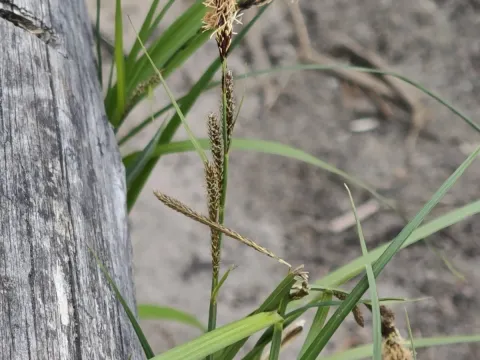
Sharp-leaved sedge
Carex acuta
Sharp-leaved sedge (Carex acuta) belongs to the Cyperaceae family. It is a perennial herbaceous plant naturally occurring in moist meadows, along riverbanks, and in floodplains throughout Eurasia.
What the section contains
Sharp-leaved sedge
The plant exhibits high ecological plasticity, preferring well-aerated but permanently moist or waterlogged soils. It tolerates prolonged flooding, which makes it valuable for floodplain agriculture and land management.
The crop has low soil cultivation requirements; however, maintaining an optimal hydrological regime is crucial for high-quality green mass production in cultivated areas.
From an agronomic perspective, Carex acuta is valued as a groundcover plant that helps stabilize shorelines and prevent soil erosion. It plays an active role in the natural formation of sod.
The plant thrives in moderate climates with sufficient rainfall. During drought periods without waterlogging, vegetation significantly slows down, leading to stem coarsening.
The agricultural use of Carex acuta is primarily directed toward meadow management in difficult-to-access moist areas. In the tillering phase, it provides a sufficient volume of green mass suitable as roughage.
It is important to note that the nutritional value of the plant depends significantly on the time of mowing. Maximum protein content is observed before the onset of the flowering and seed-bearing phases.
Hay yields in natural meadows can vary, but with proper hydrological management, the sedge can provide stable biomass volumes, outperforming many other hygrophytic species.
Specialists highlight the potential for using this species in phytoremediation for wastewater treatment and the stabilization of organic soils. This secondary use is becoming increasingly relevant in modern agriculture.
As a bedding material, the sedge is also widely used due to its high hygroscopicity and fiber durability, which is essential for livestock farm facilities.
Carex acuta possesses high resistance to most typical agricultural diseases affecting cereals. This is attributed to the specific growing conditions to which few phytopathogens are adapted.
Among potential threats are rust fungi, which may develop under conditions of excessive stand density and poor ventilation, negatively impacting the quality of the harvested raw material.
Pests such as larvae of certain fly or weevil species may damage the generative organs of the plant, though they rarely cause significant damage to wild populations.
The main danger for the crop is a disruption of the hydrological balance, particularly sharp soil desiccation, which makes the plant vulnerable to competition from more aggressive dry-land weeds.
In intensive agroecosystems, it is necessary to monitor the purity of the planting material to avoid the introduction of harmful nematodes that attack the root system in waterlogged environments.
Harvesting Carex acuta is recommended during the early flowering stage. This ensures an optimal balance between the quantity of harvested dry mass and its nutritional qualities.
For mechanized mowing, specialized mowers designed for operation on soft soils with low bearing capacity are used to avoid damaging the sod layer.
After mowing, the mass requires thorough field curing, as its specific tissue structure causes it to release moisture slowly. Using tedders allows for a significant acceleration of the hay drying process.
Storage of harvested hay should be conducted in dry, well-ventilated areas. Sharp-leaved sedge is prone to rapid quality loss in high humidity, which can lead to mold development.
In cases where the crop is used as bedding, requirements regarding harvest timing are less stringent; however, it is essential to ensure biomass collection before mass seed shedding occurs.