
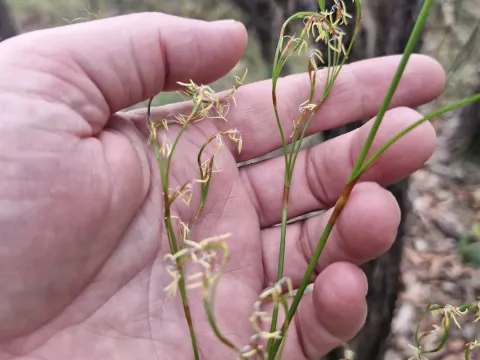
Curly Wig
Caustis flexuosa
Curly Wig, scientifically known as Caustis flexuosa, is a unique perennial sedge belonging to the Cyperaceae family. It is native to the diverse landscapes of Australia, thriving primarily in sandy and nutrient-poor soil conditions often found in heathlands and open woodlands.
What the section contains
Curly Wig
The plant is easily recognized by its wiry, curly stems that form dense, compact clumps. These stems are highly adapted to environmental stress, exhibiting a flexibility that allows them to withstand heavy winds and drought conditions without breaking or drying out prematurely.
Regarding soil requirements, this species demands excellent drainage. It is naturally evolved to survive in acidic, sandy soils and fails to thrive if the substrate remains saturated for long periods, which often leads to root rot.
In terms of climate, it requires full sun exposure to maintain its characteristic compact shape and vibrant appearance. It is remarkably drought-tolerant, making it an ideal candidate for water-wise landscaping and xeriscaping projects in temperate regions.
From a horticultural perspective, while not a commercial food crop, it serves as an excellent ornamental plant for ecological restoration and sustainable garden designs, emphasizing the beauty of native Australian biodiversity.
Curly Wig possesses a strong natural resistance to common plant diseases. Its rigid, fibrous stems do not provide a favorable environment for fungal colonization, provided that drainage is adequate.
The most significant threat to the plant's health is poor horticultural practice, specifically over-irrigation. Excessive moisture in the root zone quickly promotes the growth of pathogens that cause root decay.
Pest pressure is minimal for this species. Most insects avoid feeding on the plant due to its tough, wiry texture and lack of succulent tissues, making it a very low-maintenance species for gardeners.
Competition from invasive plant species can pose a threat in non-native environments, especially if the soil is enriched with fertilizers, which allows more aggressive weeds to outcompete the sedge.
Monitoring the acidity levels of the soil is recommended, as drastic changes in pH can disrupt the plant's nutrient uptake, leading to chlorosis and general loss of vigor.