
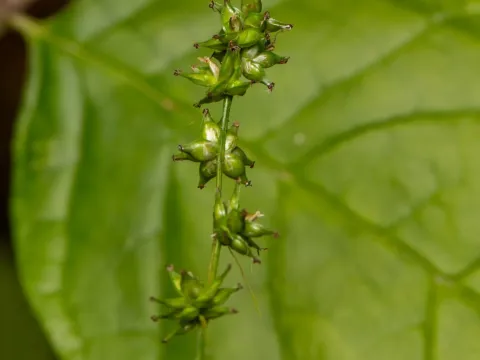
Curly-styled wood sedge
Carex rosea
Carex rosea, commonly known as curly-styled wood sedge, belongs to the Cyperaceae family. It is a perennial, tufted grass native to woodlands in North America, where it thrives in shaded, nutrient-rich environments.
What the section contains
Curly-styled wood sedge
The plant is highly valued for its adaptability to low-light conditions, making it an excellent choice for woodland gardens or shaded border areas. It prefers moist, well-draining soils rich in organic matter, such as leaf mold or compost-amended loam.
Regarding climate requirements, this sedge is hardy and can withstand a variety of temperature fluctuations. It remains evergreen in milder climates, though in colder regions, it may partially die back, requiring a thorough cleanup in early spring.
Maintenance is relatively straightforward: it requires regular, moderate watering to keep the soil consistently moist. During dry summers, supplemental irrigation is necessary to prevent the leaf tips from browning and to maintain the plant's structural integrity.
For propagation, the easiest method is dividing the clumps in the spring or autumn. Regular division not only creates new plants but also prevents the center of the clump from becoming sparse as the plant ages over the years.
Carex rosea is remarkably resistant to major diseases, making it a low-maintenance landscape plant. Most issues arise due to improper environmental conditions rather than pathogens or insects.
Root rot is the most common concern, usually occurring in heavy clay soils with poor drainage. To mitigate this risk, ensure the planting site is elevated or amended with sand and organic materials to facilitate water movement.
Fungal leaf spots can occur if plants are spaced too closely, limiting airflow. Proper spacing during initial planting is crucial for keeping the foliage dry and preventing the buildup of humidity within the plant base.
In terms of pests, slugs and snails are the primary concern during the damp conditions of spring. They can feed on tender foliage, so implementing physical barriers like copper tape or diatomaceous earth around the base is often sufficient.
While deer and rodents generally avoid sedges, occasional damage can occur during severe winters if other food sources are scarce. Protecting young or newly established clumps with light netting can provide an effective deterrent.