
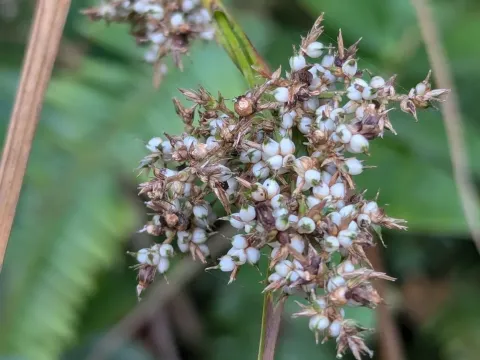
Cross-leaved sedge
Carex cruciata
Cross-leaved sedge (Carex cruciata) belongs to the large family of Cyperaceae. It is a perennial herbaceous plant native to the tropical and subtropical regions of Asia, including India, China, and various countries across Southeast Asia.
What the section contains
Cross-leaved sedge
The plant thrives in moist habitats and is frequently found along forest edges, near water bodies, and on shaded slopes. It shows high adaptability to different soil types, although it grows best in loamy soils that possess good drainage and adequate organic content.
The plant is characterized by its distinct morphology: strong rhizomes form dense clumps, and narrow long leaves grow in rosettes. Its inflorescences have a specific cross-like shape, which gives the species its common and scientific name, distinguishing it from other sedge species.
For optimal development, cross-leaved sedge requires stable temperature conditions without severe frosts. While it can withstand periods of short-term drought, it is most productive when provided with consistent moisture during the growing season and moderate light exposure.
In agricultural and industrial contexts, the plant is valued as a potential source of natural fibers used in traditional craft production. It is also utilized in landscape design as an ornamental plant, suitable for planting in wetlands or along the borders of ponds and streams.