
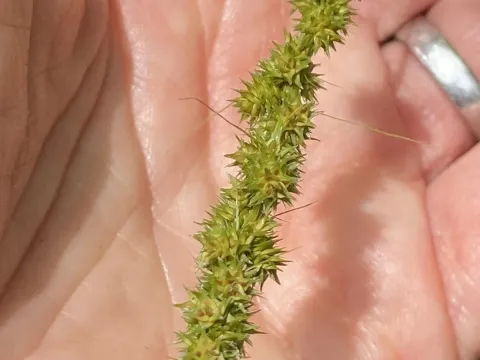
Fox sedge
Carex vulpinoidea
Fox sedge (Carex vulpinoidea) is commonly propagated from seeds, which should be sown in late autumn or early spring. If sowing in spring, cold stratification is recommended to improve the germination rate of the seeds.
What the section contains
Fox sedge
When seeding in restoration sites, broadcast the seeds over prepared soil. Press the seeds into the soil surface to ensure good seed-to-soil contact, as they require light to germinate effectively and should not be buried deeply.
For container-grown nursery stock, seedlings should be transplanted during the early growing season. This timing allows the plants to establish a robust root system before the onset of summer drought or heat stress.
Vegetative propagation via clump division is an effective alternative for landscaping purposes. Divide mature, healthy plants in the spring before active growth begins to ensure quick re-establishment.
Sufficient moisture must be maintained throughout the germination and early establishment phase. In dry conditions, consistent irrigation is vital to prevent seedling desiccation and ensure long-term survival.
Fox sedge is a native North American perennial in the Cyperaceae family. It is widely recognized for its preference for wet meadows, marshes, and the margins of ponds or streams, making it a key species for hydro-botanical projects.
This species is highly adaptable to various soil types, ranging from nutrient-rich silts to heavy, compacted clays. It excels in soils that are prone to periodic inundation and can tolerate a wide range of pH levels.
Optimal growth occurs in full sun, though the plant can persist in partial shade. In shaded conditions, the plant may become more lax and less productive in terms of biomass and seed head production.
The plant features distinct inflorescences that resemble a fox's tail, typically rising from dense, fibrous, and tufted clumps. The foliage is narrow and stiff, providing structural integrity to the plant throughout the growing season.
Fox sedge is exceptionally hardy and plays a significant role in improving soil structure. Its deep, dense root network makes it an excellent candidate for stabilizing banks and preventing erosion in riparian zones.
Fox sedge is generally resistant to major pests and diseases, which enhances its suitability for sustainable and low-input ecological restoration projects. It rarely requires any chemical intervention for health maintenance.
Root rot can become a potential threat if the soil remains stagnant and poorly drained for extended periods during high-temperature months. Proper site selection and ensuring natural water movement are the best preventatives.
While few insects attack this plant, young seedlings are sometimes vulnerable to herbivores or competitive invasive weeds. Protecting the site from heavy weed encroachment during the first year is the most critical management activity.
The species is quite competitive in its natural habitat, often colonizing open, disturbed sites rapidly. While this is beneficial for reclamation, it should be managed to avoid unintentional spreading into adjacent, sensitive habitats.
In conclusion, Fox sedge is a low-maintenance perennial that offers robust resistance to environmental stressors, making it a reliable choice for professional environmental engineering and landscaping.