
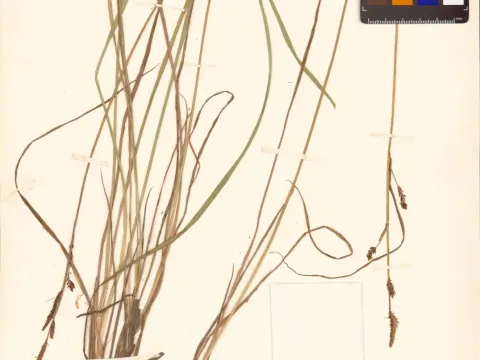
Thunberg's Sedge
Carex thunbergii
Thunberg's sedge (Carex thunbergii) is a perennial herbaceous plant belonging to the Cyperaceae family. Naturally distributed in East Asia, it is primarily found in wetland ecosystems, including marshes, floodplains, and the banks of various water bodies.
What the section contains
Thunberg's Sedge
The plant is characterized by a vigorous rhizomatous root system, which enables it to form dense, stable colonies. The stems typically range from 30 to 80 cm in height and support narrow, linear leaves that are characteristic of the genus. Its biological structure is highly adapted to water-saturated conditions.
The crop thrives in soil types that are unsuitable for conventional agriculture, specifically peat-rich and marshy soils with high moisture content. It prefers high humidity levels and can withstand temporary flooding, which is a major advantage for its survival in riparian zones.
Climate requirements include a preference for temperate, cool environments with reliable precipitation. Thunberg's sedge exhibits excellent cold tolerance, making it suitable for cultivation in northern climatic regions where it remains dormant during the winter months.
Agricultural management is relatively low-input. The primary requirement is maintaining consistent moisture levels. In areas designated for wetland management, it serves as a natural tool for stabilizing banks and improving the hydraulic properties of the soil.
Thunberg's sedge is utilized for both forage production and industrial applications. While not a primary fodder crop, it provides a supplementary source of biomass in regions where high-quality grasses are unavailable due to heavy waterlogging.
Harvesting should be timed precisely before the plant tissues become too lignified (woody). Early harvesting ensures better digestibility for livestock, though the nutritional profile is generally lower compared to traditional forage grasses like clover or timothy.
Industrial applications include the use of harvested leaves in the craft sector. The fiber is durable and resistant to water, making it an excellent material for woven mats, baskets, and traditional agricultural tools used in local livelihoods.
Post-harvest management is crucial, focusing on immediate drying to prevent fungal growth and decomposition. Proper curing ensures the longevity of the fibrous materials, which can then be stored for several seasons without significant loss of quality.
Sustainable harvesting techniques involve leaving a portion of the rhizome system intact, which facilitates fast regrowth. This regenerative capacity allows for long-term productivity without the need for intensive soil tilling or site replanting.