
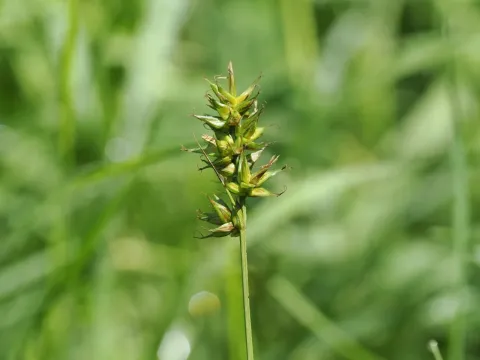
Spiked sedge
Carex spicata
Carex spicata, commonly known as spiked sedge, is a perennial herbaceous plant belonging to the Cyperaceae family. While often found in the wild, it is increasingly valued in land management and restorative agriculture for its ability to stabilize soil and maintain biodiversity.
What the section contains
Spiked sedge
The optimal sowing time for spiked sedge is late autumn or early spring. Seeds generally require a period of cold stratification to overcome dormancy, ensuring uniform germination rates when temperatures stabilize in the spring.
The seeding rate is typically set at 10-15 kg per hectare, depending on site goals. Seeds should be sown shallowly, ideally at a depth of 1-2 cm, as they are small and possess limited energy reserves for emergence if buried too deeply in the soil profile.
During the first year, establishment is slow as the plant focuses its energy on developing a robust root system. Providing a weed-free seedbed is critical during this period to ensure the young plants are not overwhelmed by faster-growing competitive grasses.
Spiked sedge is indigenous to a wide range of temperate regions across Europe and Western Asia, demonstrating significant environmental plasticity, which allows it to thrive in diverse geographical contexts.
This species prefers moist to well-drained fertile soils, showing a preference for loams or clay-based substrates. While it tolerates seasonal waterlogging, it performs best in soils where the water table is consistent but not stagnant.
Soil pH levels should ideally range between 5.5 and 7.0 for optimal nutrient availability. Although adaptable, the plant shows the best vegetative growth in conditions that provide adequate moisture throughout the growing season.
Temperature requirements are moderate, as the plant is hardy and well-adapted to the climatic conditions of temperate zones. It handles frost effectively, making it a reliable choice for perennial cover in cold-climate regions.
Agronomic management involves periodic fertilization with nitrogen-based compounds to boost green mass production, especially if the crop is intended for forage or fiber. Potassium applications help improve overall resilience and drought tolerance.
The plant displays good shade tolerance compared to other perennial grasses, allowing it to be utilized in agroforestry or partially shaded restoration sites where other species might fail to establish.
Yield potential of Carex spicata is largely influenced by moisture availability and soil fertility levels. Under optimal conditions, annual yields of green mass can reach 15-20 tons per hectare, depending on the cutting regime employed.
As a forage crop, it is generally considered moderate in nutritional quality, often serving better as a component in mixed-species hay rather than as a sole source of feed for livestock, due to its fiber content.
Harvesting for hay should be timed carefully at the spike development stage. Delaying harvest leads to a significant increase in crude fiber and silica content, which reduces palatability and digestibility for cattle and other ruminants.
Seed yield is consistent, reaching approximately 300-400 kg per hectare. Because seeds can shatter upon maturity, growers must monitor the field closely to capture the crop before maximum seed loss occurs.
Beyond agricultural forage, the species is valuable for erosion control and sediment capture on slopes, providing a secondary yield in the form of ecosystem services and land conservation benefits.
Carex spicata is generally resistant to many common field crop diseases. However, high-humidity environments may encourage fungal issues such as leaf rust, which can degrade the quality of the foliage if left unmanaged.
Common pests include aphids and specialized dipterous larvae that may attack stems or inflorescences. Integrated Pest Management (IPM) strategies, focusing on habitat maintenance and natural predators, are usually sufficient to control these threats.
Cultural control, such as proper crop rotation and timely mowing to prevent pest buildup, is prioritized over chemical interventions. Keeping field margins clear of weeds helps reduce the reservoir population of potential insect pests.
The resilience of the species makes it a low-input crop, requiring few pesticide applications. This makes it an ideal candidate for low-intensity, sustainable agricultural systems that prioritize environmental health.
Monitoring for signs of nutrient deficiency or water stress is the primary method of preventing susceptibility to opportunistic pathogens or pest infestations in established stands.
Mechanical harvesting is conducted using standard mower-conditioners. Cutting should be performed while the plants are still in the vegetative or early reproductive phase to ensure the best balance between mass and nutritional value.
After cutting, the material should be turned in the swath to facilitate even drying. Reducing moisture content to below 15% is essential for safe storage and the prevention of heating or mold in hay bales.
Seed harvesting requires a combine harvester set to specific parameters to handle the light, small seeds. Proper adjustment of air flow and drum speed is critical to minimize loss and ensure seed purity.
Post-harvest cleaning is necessary to remove chaff and non-viable seeds, ensuring high germination potential for future seasons. Storing seeds in a cool, dry place preserves viability for several years.
Successful harvest management ensures the long-term vigor of the perennial stand, promoting rapid regrowth in the following season and supporting stable yields over multiple years of operation.