
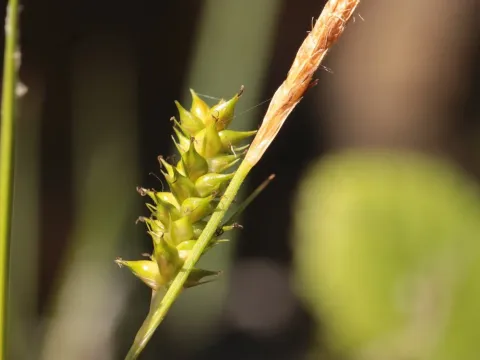
Dotted sedge
Carex punctata
Dotted sedge (Carex punctata) is a perennial herbaceous plant belonging to the Cyperaceae family. It is typically found in moist environments, such as damp meadows, marshes, and the margins of water bodies, where it plays a role in stabilizing soil.
What the section contains
Dotted sedge
Native to Europe, parts of Asia, and Northern Africa, the plant has adapted to diverse climatic conditions. In an agricultural context, it is often managed as a component of wild hay meadows, contributing to the overall biodiversity and biomass production of low-lying areas.
The plant thrives in soil conditions characterized by high water tables, including peat, silt, and heavy clay soils. It shows remarkable resilience to periodic flooding, making it suitable for land that is unsuitable for intensive cereal cultivation.
Botanically, Carex punctata is characterized by its loosely tufted growth habit and stiff, upright stems. Its leaves are distinctly bright green, and its inflorescences develop into unique, punctate (dotted) perigynia, which aid in the dispersal of seeds through water or animals.
Agricultural management is generally low-intensity, focusing on maintaining favorable hydrological conditions. Because it is highly specialized for moisture, successful cultivation requires consistent water supply rather than complex fertilization regimens.
The primary threat to Dotted sedge populations is soil drainage. Large-scale land reclamation projects that lower the water table create unfavorable conditions, forcing the species to retreat and allowing drier meadow grasses to outcompete it.
Like many sedges, this plant can be susceptible to fungal infections, particularly rusts, during seasons with prolonged high humidity. Such diseases can impact the vigor of the plant, reducing its biomass contribution to the forage stand.
Pests such as certain species of sedge flies or leaf-mining insects can affect its reproductive development. While generally robust, high levels of infestation can reduce seed set, which might be a concern if the species is being cultivated for restoration purposes.
Overgrazing poses a structural threat to the stands. Although the foliage contains silica, making it less palatable to livestock compared to traditional grasses, excessive treading and grazing can destroy the root structures and expose the soil to erosion.
Integrated management plans for sites with Dotted sedge emphasize the importance of monitoring moisture levels. Avoiding chemical intervention is a standard practice, as it preserves the fragile wetland ecosystem that the species relies upon for its survival.