
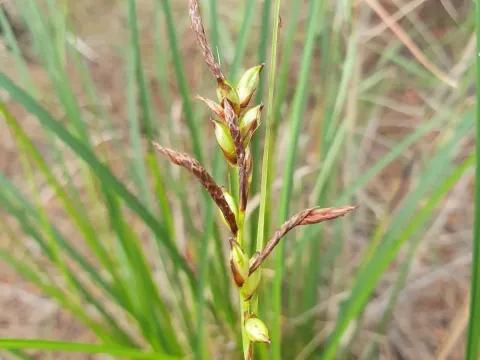
Carex illegitima
Carex illegitima
Carex illegitima is a perennial herbaceous plant belonging to the Cyperaceae family. Sowing is typically carried out in late autumn, allowing the seeds to undergo natural stratification during the winter months.
What the section contains
Carex illegitima
Vegetative propagation via rhizome division is an alternative and often more successful method, which should be performed in early spring before the start of the vegetative phase.
Seeds should be sown at a shallow depth of 1-2 centimeters to ensure proper germination and contact with moist soil layers, avoiding deep burial which can hinder development.
For high-density stands, seeds or divisions should be spaced 15–20 centimeters apart, facilitating uniform growth and ease of management during the initial stages.
Optimal site preparation involves clearing the ground of competing weeds and lightly tilling the soil to create a favorable environment for rapid root establishment.
This species is highly adapted to wet environments and thrives in lowland areas, marshes, or fields with consistently high groundwater levels.
It prefers peaty or loamy soil types that maintain high moisture content throughout the growing season, which is essential for maximizing biomass production.
Carex illegitima exhibits excellent cold hardiness, making it suitable for cultivation in regions with harsh winters and variable spring temperatures.
While it can tolerate partial shade, it achieves the highest yield and optimal development when grown in open, sunny locations with minimal canopy obstruction.
Balanced fertilization, particularly with nitrogen and potassium, significantly improves the plant's structural integrity and overall vigor during the peak growing season.
Yield capacity typically ranges from 1.5 to 2.5 tons of dry matter per hectare, depending on local environmental conditions and the quality of agricultural management.
Productivity generally increases as the plantation matures, peaking in the second and third years after establishment once the root system has fully expanded.
Regular maintenance, including selective weeding and targeted fertilization, can boost biomass output by up to 30% compared to unmanaged wild stands.
The nutritional profile of the harvested material is highest during the early flowering stage, which dictates the optimal timing for harvesting operations.
Continuous monitoring of plant health allows farmers to adjust irrigation or nutrient delivery, ensuring stable yields across multi-year cycles.
Fungal diseases, such as rust and smut, are the primary threats to Carex illegitima, especially in regions with high humidity and limited air circulation.
Effective management includes maintaining proper spacing between plants and removing infected debris from the field to prevent the spread of pathogens.
Pest threats include soil-dwelling larvae that attack the roots and certain leaf-feeding insects that can significantly reduce leaf mass if left unchecked.
Integrated pest management, including the use of biological control agents and resistant practices, is recommended to keep damage below economic thresholds.
Regular field surveys during the growing season help in detecting early signs of disease, allowing for localized treatments rather than widespread chemical application.
The optimal harvest time occurs at the onset of flowering, which balances the volume of the biomass with the concentration of key nutrients for animal feed.
Mechanical harvesting is best performed with rotary mowers, maintaining a stubble height of at least 5-7 centimeters to promote rapid regrowth of the plant.
Proper drying or wilting of the harvested biomass is crucial for preventing spoilage and mold development, especially when the crop is intended for long-term silage.
Seed harvesting should be carefully timed to coincide with the brown-color stage of the seeds to minimize shattering losses during collection and transport.
Post-harvest storage requires well-ventilated conditions to maintain the structural quality of the leaves and prevent degradation of the nutritional components.