
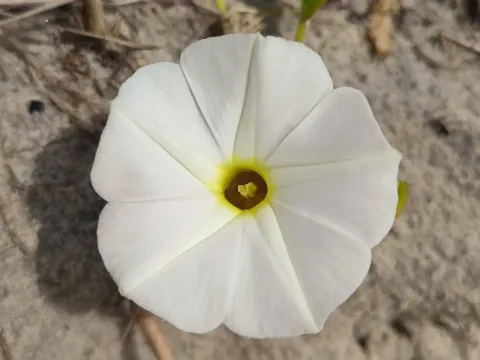
Beach morning glory
Ipomoea imperati
Beach morning glory (Ipomoea imperati) is a perennial vine belonging to the Convolvulaceae family. It is widely recognized for its prostrate growth habit and long, creeping stems that root at the nodes.
What the section contains
Beach morning glory
The plant is native to tropical and subtropical coastal regions worldwide. It thrives in maritime environments, particularly on sand dunes, where it acts as a primary stabilizer against wind erosion.
It is classified as a halophyte, meaning it has physiological adaptations allowing it to grow in high-salinity environments such as coastal beaches and sandy substrates.
The cultivation requirements are specific: high solar radiation is essential, and the soil must be well-drained. It does not tolerate waterlogging, which makes sandy or sandy-loam soils the only suitable medium.
In terms of practical use, it is a vital ecological tool. Its ability to create a dense green mat helps maintain the structure of sand dunes and prevents the inland migration of coastal sands.
The primary diseases affecting Ipomoea imperati include fungal infections such as powdery mildew, which can develop if there is insufficient air circulation or high humidity.
Insect pests include various species of beetles and caterpillars that feed on the foliage. While these rarely destroy a mature plant, they can retard growth and reduce the plant's effectiveness in stabilizing sand.
Root-knot nematodes are a potential underground threat that can affect plant vitality in sandy environments by attacking the root system directly.
Herbivory by local coastal fauna, including small mammals and insects, is a normal part of the ecosystem but can be problematic if population numbers of herbivores surge unexpectedly.
Habitat destruction remains the most significant threat to the survival of beach morning glory colonies, specifically through coastal development and sand compaction caused by foot traffic.