
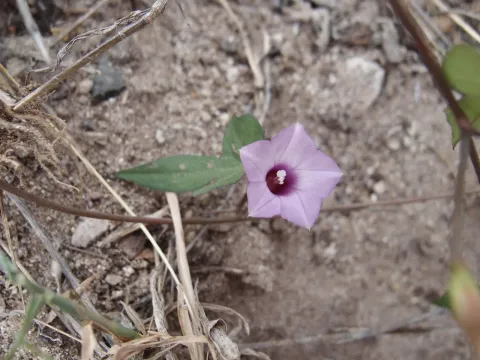
White morning glory
Ipomoea leucantha
Ipomoea leucantha, commonly known as white morning glory, is a climbing annual herb belonging to the Convolvulaceae family. It is widely recognized as a problematic weed in agricultural landscapes, particularly in soybean and corn production systems.
What the section contains
White morning glory
Germination typically occurs when soil temperatures reach 18 to 22 degrees Celsius. The seeds exhibit high viability and can germinate throughout the growing season whenever moisture conditions are favorable.
Optimal planting depth for this species is 2–4 centimeters. The plant produces a vigorous taproot early in development, which allows it to establish quickly even in compacted soils.
The seedling stage is characterized by rapid hypocotyl elongation, enabling the plant to reach the light and begin twining around available support structures within days of emergence.
In farming regions, the synchronization of Ipomoea emergence with major crop sowing makes it a significant competitor for space, water, and essential soil nutrients.
White morning glory thrives in warm climates with high light intensity. It is highly photophilous and performs poorly under dense canopy coverage, making it a major threat to crops with delayed row closure.
The plant grows best in fertile, well-drained loamy soils. It demonstrates significant tolerance for varying pH levels, though neutral to slightly alkaline soils provide the best growth conditions.
Moisture is a critical requirement for the vigorous vining habit. While the plant can withstand short drought spells, sustained moisture promotes explosive biomass accumulation.
Structural support is essential for the mature phase of the plant. Without vertical supports, the morning glory will crawl along the ground, creating dense mats that suppress other vegetation.
Nutrient uptake efficiency is high, especially for nitrogen. The plant quickly consumes nitrogenous fertilizers applied to the field, thereby depriving the primary crop of nutrition.
Fungal pathogens such as white mold (Sclerotinia) and powdery mildew are common threats, especially in areas where high humidity is maintained under the plant's dense foliage.
Pests, including various beetle species and aphid colonies, frequently target the succulent leaves and developing flower buds, sometimes acting as vectors for plant viruses.
Root-knot nematodes can colonize the roots, though this rarely eliminates the weed, as Ipomoea leucantha often maintains a high level of resilience.
Chemical control is the most frequent management strategy, usually involving pre-emergence and post-emergence herbicides tailored to the crop cycle.
Mechanical harvesting is severely complicated by the twining nature of the plant, which wraps around agricultural machinery, causing significant downtime and yield losses during collection.