
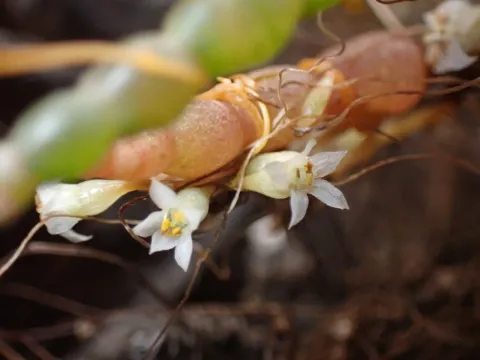
Dodder
Cuscuta
Dodder is a parasitic plant that lacks chlorophyll and functional roots, meaning it does not grow from seeds sown for agricultural production. It acts as a severe weed, spreading primarily through contaminated crop seeds, agricultural machinery, and movement of soil or fodder.
What the section contains
 Australian dodder
Cuscuta australis R. Br.
Australian dodder
Cuscuta australis R. Br.
 Field dodder
Cuscuta campestris Yunck.
Field dodder
Cuscuta campestris Yunck.
 Five-angled dodder
Cuscuta pentagona Engelm.
Five-angled dodder
Cuscuta pentagona Engelm.
 Flax dodder
Cuscuta epilinum Weihe
Flax dodder
Cuscuta epilinum Weihe
 Flax dodder
Cuscuta planiflora Ten.
Flax dodder
Cuscuta planiflora Ten.
 Giant dodder
Cuscuta reflexa Roxb.
Giant dodder
Cuscuta reflexa Roxb.
 Greater dodder
Cuscuta europaea L.
Greater dodder
Cuscuta europaea L.
 Lesser dodder
Cuscuta epithymum (L.) L.
Lesser dodder
Cuscuta epithymum (L.) L.
 Pretty dodder
Cuscuta indecora Choisy
Pretty dodder
Cuscuta indecora Choisy
Dodder
Seeds of Cuscuta species germinate within the top few centimeters of soil when temperatures range between 15 and 25 degrees Celsius. If the young seedling does not reach a suitable host plant within a few days, it will die because it cannot sustain itself through photosynthesis.
The germination period can be extended over several months, coinciding with the growth cycles of common crops like alfalfa, clover, and various vegetables. This long-lasting ability to sprout makes the parasite extremely persistent in commercial farming environments.
Once a suitable host is found, the dodder wraps its thread-like stems around the stem of the host and develops specialized organs called haustoria. These structures penetrate the tissues of the crop, creating a vascular connection to extract nutrients and water.
The seeds of this parasite remain viable in the soil for 5 to 10 years or longer. This resilience makes it a significant quarantine pest, necessitating strict monitoring and rigorous cleaning of all seeds entering the farming operation to prevent infestations.
Dodder depends entirely on host plants for its survival, requiring species with succulent stems that can provide a steady supply of sap. The health and vigor of the dodder are directly linked to the health and nutrient availability within the host organism.
Environmental humidity is a critical factor for the expansion of dodder infestations. Warm, humid conditions accelerate the growth rate of the parasite, allowing it to spread across a field rapidly and form dense, tangled mats that eventually kill the host plants.
While sunlight is not required for the parasite to perform photosynthesis, warm weather is generally conducive to its rapid metabolism and flowering. The plant produces large numbers of tiny seeds, which are then disseminated by wind, water, and human activities.
Soil type is of secondary importance to the parasite, but good soil fertility helps the host plant grow, which in turn provides more resources for the dodder to thrive. High-density planting also assists the parasite in moving from one host to another with ease.
Effective management requires controlling the crop environment. By managing irrigation and keeping fields free of volunteer host plants, farmers can make conditions less favorable for the establishment of this parasitic intruder during the growing season.
The primary threat posed by dodder is the drastic reduction in crop yields and the potential for total crop loss in heavily infested areas. The parasite depletes the plant's resources, causing stunting, wilting, and eventually the death of the crop host.
Dodder acts as a biological vector for numerous plant viruses. As it extracts fluids from multiple plants in sequence, it easily transfers pathogens, leading to the rapid spread of viral and fungal diseases across a field that would otherwise be difficult to control.
Biological control agents, including specific insects and fungal pathogens, have been studied for their ability to suppress dodder populations. However, these methods are not yet widely available for broad-scale agricultural use and are often unpredictable in field settings.
Chemical control usually involves contact herbicides or pre-emergent treatments. However, because dodder is so closely intertwined with the host crop, application must be very precise to avoid causing damage to the commercial plants being harvested.
Physical removal remains the most reliable method for controlling small outbreaks. This involves cutting the infested patches below the point of attachment and removing the biomass for destruction. This prevents the formation of new seeds and breaks the life cycle of the parasite.