
Five-angled dodder
Cuscuta pentagona Engelm.
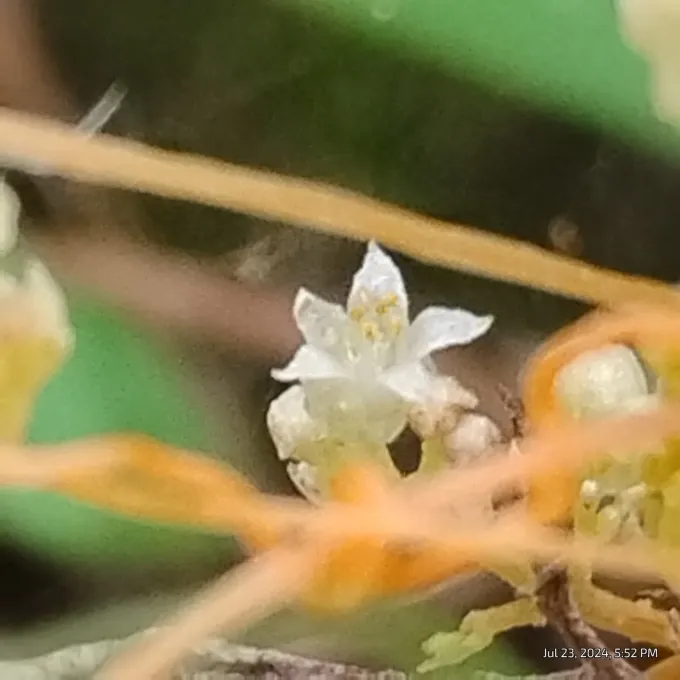
Description
Growing requirements
Five-angled dodder (Cuscuta pentagona) is a parasitic seed plant belonging to the Convolvulaceae family. As an obligate parasite, it lacks chlorophyll and a functional root system, meaning it must attach to a host plant to extract nutrients for survival and reproduction.
Native to North America, this species has become a significant invasive weed globally. It thrives in diverse climates, particularly in agricultural regions with warm summers that support rapid vine growth and the development of large, dense mats that engulf host plants.
The plant grows best in areas with high light exposure and access to suitable hosts, such as alfalfa, sugar beets, and tomatoes. Without a host, the seeds can remain dormant in the soil for several years, waiting for favorable conditions to germinate and begin the life cycle.
Management requires rigorous field sanitation and the use of certified, dodder-free seed. Since the seeds are extremely small and easily mistaken for debris or other weed seeds, high-precision cleaning of agricultural commodities is essential to prevent regional spread.
Effective agricultural practices include crop rotation with non-host species, which helps deplete the seed bank in the soil over time. Deep plowing can also bury seeds deeper than their capacity to emerge, although this is only a partial solution for long-term infestation control.
Main diseases and pests
The primary threat posed by Cuscuta pentagona is the physical and physiological damage to crops. By inserting haustoria into the host’s stem, the dodder drains water, sugars, and minerals, significantly reducing the host's vitality and overall agricultural yield.
Beyond nutritional loss, the dodder serves as a bridge for viral plant diseases. Because it physically connects multiple plants in a field, it facilitates the rapid spread of viral pathogens that might otherwise remain contained within a single plant or small area.
Disease management is extremely challenging once the parasite has established its connection. Chemical control via selective herbicides is usually only effective in the pre-emergence or very early post-emergence stages before the dodder establishes a strong vascular bond with the host.
Mechanical destruction is the most reliable method for controlling small outbreaks. Affected crop areas must be mowed, raked, and burned to ensure that no viable seed heads or stem fragments remain to continue the infestation cycle or contaminate soil.
- Strict quarantine inspections of imported machinery.
- Sanitation of equipment when moving between fields.
- Monitoring of field edges and irrigation channels.
- Use of herbicide application during the seedling stage.
- Destruction of contaminated crop residue by incineration.