
Greater dodder
Cuscuta europaea L.
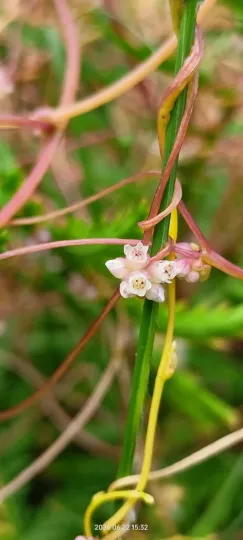
Description
Growing requirements
Greater dodder (Cuscuta europaea L.) is a parasitic plant species belonging to the Convolvulaceae family. It is distinct in its lack of roots and chlorophyll, making it completely dependent on a host plant for survival, water, and essential nutrients throughout its lifecycle.
The botanical structure consists of thin, thread-like stems that coil around the host. These stems develop haustoria, which are specialized organs that penetrate the host tissue to extract sap. This parasitic process allows the dodder to thrive even in conditions where independent growth would be impossible.
This species is widely distributed across Europe and Asia. It typically thrives in humid environments such as riparian corridors, shrublands, and dense forest edges. However, its presence in agricultural fields is a major concern, as it targets both herbaceous crops and woody ornamental plants.
Environmental requirements for growth are relatively simple: the dodder requires an adequate host and stable temperature conditions. Germination occurs from seeds in the soil. Without finding a host within a few days of germination, the seedling will die, as it lacks the energy reserves to support long-term autonomous life.
Agronomic management focuses on strict phytosanitary measures. Farmers are advised to use high-quality, weed-free seeds, practice rotation with non-host crops, and implement deep tillage. Keeping headlands and boundaries clear of wild host plants is crucial to prevent the initial spread of infestation into fields.
Main diseases and pests
As a quarantine weed, the greater dodder poses a severe economic threat. It stunts the growth of host crops, redirects nutrients meant for fruit or biomass production to support its own development, and significantly reduces the overall quality of agricultural output.
Beyond physical drainage, it acts as a highly efficient vector for viruses and phytoplasmas. Through the haustoria, pathogens are transmitted from infected plants to healthy ones, leading to rapid and widespread outbreaks of diseases that can destroy entire harvests within a single season.
Crops affected by dodder show visible signs of stress: leaves may yellow or wilt, photosynthesis is hindered, and flowering or fruiting stages are often severely disrupted. In forage production, the presence of dodder can render the crop unsafe or unpalatable for livestock consumption.
Chemical control involves the use of pre-emergent or post-emergent herbicides, though these must be applied cautiously to avoid damaging the host plants. Given the biological proximity between the parasite and the host, manual removal remains the most effective control method for small infestations.
Long-term control is difficult because seeds remain viable in the soil for up to a decade. A comprehensive management plan, including continuous monitoring and burning of infested biomass, is required to break the reproductive cycle and protect the field from future infestations.