
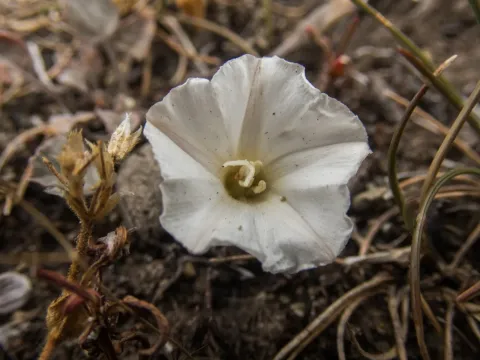
Convolvulus verecundus
Convolvulus verecundus
Convolvulus verecundus belongs to the Convolvulaceae family. This species is primarily adapted to arid steppe regions, showing a distinct resilience to harsh environmental conditions.
What the section contains
Convolvulus verecundus
The sowing period typically starts in mid-spring once the soil temperature consistently reaches 10-12 degrees Celsius, which is optimal for uniform germination.
Seeds should be planted at a shallow depth of approximately 2-3 centimeters to ensure proper establishment before the dry summer heat begins.
In terms of population density, spacing should be adjusted to allow for sufficient airflow, preventing the development of humidity-related disorders at the base of the plants.
Early-stage management involves careful weeding, as the plant is sensitive to competition from aggressive grasses during its initial growth phase.
The crop thrives in well-drained, light soils with a neutral or slightly alkaline chemical profile. High sand content is generally preferred for optimal root development.
Sunlight is the most critical requirement for the species. Full exposure to direct sunlight is necessary to support robust vegetative growth and flower production.
As a xerophytic plant, Convolvulus verecundus excels in drought tolerance, making it an excellent candidate for regions with limited rainfall and water scarcity.
Agronomic practices focus on minimal water input. Over-irrigation can lead to root system decay, particularly if the soil lacks sufficient permeability.
Nutrient management is straightforward; excessive nitrogen should be avoided to prevent leggy growth and focus the plant's energy on building a hardy structure.
Fungal pathogens represent the main threat when the environment becomes excessively humid, often causing damping-off in younger seedlings.
Spider mites are the most common pests, particularly during hot and dry spells, as they thrive on the undersides of the leaves, reducing photosynthetic capacity.
Effective management includes integrated pest control strategies, such as removing infested plant debris and applying specific biological agents when necessary.
Monitoring the crop for signs of chlorosis or leaf curling is essential to intervene early with appropriate mineral fertilizers or corrective agronomic measures.
Proper field rotation is recommended to break the cycle of soil-borne pathogens that might otherwise accumulate in the root zone over several growing seasons.