
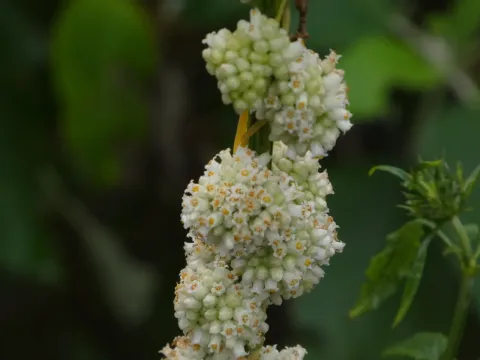
Cuscuta corymbosa
Cuscuta corymbosa
Cuscuta corymbosa belongs to the Convolvulaceae family. It is a highly specialized holoparasitic plant that lacks chlorophyll and roots, relying entirely on a host plant for its nutritional requirements.
What the section contains
Cuscuta corymbosa
The botanical structure of this parasite consists of thread-like stems that coil around the host plant. It attaches to the host by developing haustoria, which penetrate the host's vascular bundles to absorb water and nutrients.
Originally native to regions in Central and South America, this species has become a global concern due to its ability to spread through contaminated crop seeds and international trade.
Environmental requirements for Cuscuta corymbosa include warm temperatures and sufficient humidity during the initial germination and growth phases, making it particularly troublesome in summer crops.
The plant thrives on a wide variety of herbaceous hosts, showing high adaptability to different agricultural environments provided there is enough vegetative mass to support its parasitic lifestyle.
The primary threat posed by this species is the significant reduction of crop yields. By extracting essential nutrients and water, it stunts the growth of crops such as vegetables, alfalfa, and industrial plants.
Cuscuta corymbosa is also a known vector for various plant viruses. By connecting multiple plants, it creates a bridge for pathogens to spread rapidly across entire fields.
Managing this pest is exceptionally difficult because its seeds remain viable in the soil for years. A persistent seed bank makes eradication a long-term agricultural challenge.
Control strategies involve strict quarantine measures, rigorous seed testing to ensure purity, and the application of chemical control in affected zones to prevent further infestation.
Once established, the parasite is difficult to eliminate. Agronomists often recommend crop rotation with non-host species and deep tillage to bury seeds to a depth that prevents germination.