
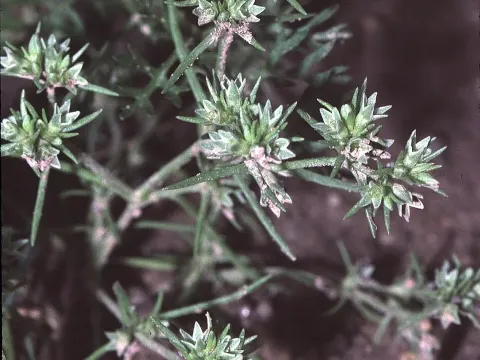
Oriental knawel
Scleranthus orientalis
Oriental knawel (Scleranthus orientalis) is a perennial herbaceous plant belonging to the Caryophyllaceae family. It is recognized for its significant resilience and ability to thrive in challenging, nutrient-poor environments where common agricultural crops often fail.
What the section contains
Oriental knawel
The plant typically inhabits dry, sandy, or rocky terrains. It is highly adapted to arid conditions, possessing a deep root system that allows it to effectively extract moisture from low-quality soils, demonstrating true xerophytic characteristics.
Its natural range includes steppe zones and semi-arid regions of Eurasia. The climate in these areas is characterized by extreme temperature fluctuations, which the Oriental knawel withstands due to its compact morphology and specialized physiological processes.
Botanically, the plant is known for its dense, mat-forming growth habit. The leaves are narrow, awl-shaped, and arranged in tight rosettes, which helps reduce evaporation surface area and protects the plant during extreme heat and drought.
In terms of agricultural and environmental value, the species is primarily studied for its soil-binding properties. It acts as a pioneer species that can stabilize shifting sands and eroded surfaces, potentially serving as a bio-indicator for desertification processes.
Oriental knawel is generally resistant to typical agricultural pests. Its tissue composition, often containing bitter or secondary compounds, serves as a natural deterrent against most insects and herbivorous animals.
Pathogenic threats are mainly limited to fungal infections triggered by prolonged waterlogging. When moisture levels exceed the plant's natural tolerance, root rot can develop, leading to the rapid decay of the characteristic dense mats.
Agricultural management of the species usually involves deep mechanical cultivation. Because of its perennial nature, simple surface tilling is often insufficient to fully eradicate the plant from fields designated for high-intensity crop production.
Competition from more aggressive, fast-growing weeds and cereal crops is the most effective way to suppress Oriental knawel. Increased soil fertility through fertilization typically shifts the balance of the ecosystem away from this hardy species.
Finally, environmental threats are mostly linked to anthropogenic changes in land use. Excessive plowing or the conversion of arid grazing lands into irrigated agricultural plots can lead to the local extinction of this specialized plant.