
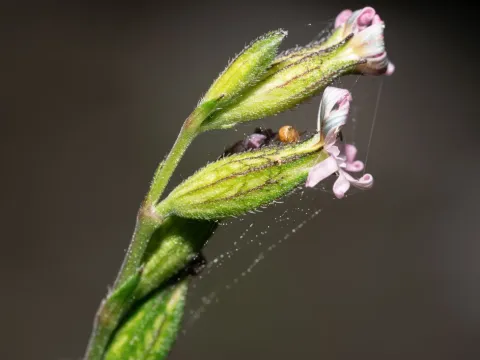
Night-flowering catchfly
Silene nocturna
The night-flowering catchfly (Silene nocturna) is a herbaceous annual plant belonging to the Caryophyllaceae family. It is primarily recognized as a wild plant or a weed rather than an agricultural crop species.
What the section contains
Night-flowering catchfly
The species originated in the Mediterranean basin. Its natural range extends across Southern Europe, Northern Africa, and parts of Western Asia, where it thrives in open, sunny habitats with relatively low moisture requirements.
The plant exhibits significant adaptability to various soil types, preferring well-drained, nutrient-poor, or sandy substrates. It is highly resistant to drought, allowing it to colonize disturbed lands and field margins effectively.
Botanically, it is characterized by glandular stems and oppositely arranged leaves. The small, often inconspicuous flowers bloom at night to attract specific nocturnal pollinators, releasing a faint scent that is typical for the Silene genus.
Agronomically, it is identified as a secondary weed. While it does not serve as a mainstream crop, it is of interest in studies related to biodiversity in arable fields and the management of weed populations in Mediterranean climate zones.
Like many plants in the Caryophyllaceae family, the night-flowering catchfly is susceptible to fungal infections such as powdery mildew, especially when cultivated in dense stands under humid conditions.
Insect pests, including aphids and various species of lepidopteran larvae, can cause significant damage to the foliage. These pests often move from wild host plants to adjacent cultivated crops, making control necessary.
Management strategies in an agricultural context focus on mechanical weeding, such as hoeing or shallow tillage, which are highly effective at suppressing early growth stages before the plant sets seeds.
Chemical control is possible using broad-spectrum or selective herbicides, although the plant's structural features, including its pubescence, can sometimes reduce the absorption of systemic chemicals.
Prevention involves consistent crop rotation and the use of clean, certified seeds for crop planting, ensuring that weed seeds are not introduced into the production area during the sowing process.