
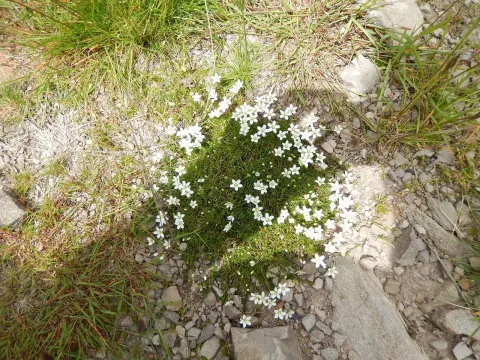
Sagina glabra
Sagina glabra
Sagina glabra, commonly known as pearlwort, is a herbaceous perennial belonging to the Caryophyllaceae family. It is highly valued for its dense, moss-like foliage that stays vibrant green throughout the growing season, making it an ideal ornamental groundcover.
What the section contains
Sagina glabra
Originating from the mountainous regions of Central and Southern Europe, this plant has adapted to survive in harsh, stony environments. Its natural habitat dictates its preference for well-draining, gritty soils rather than nutrient-rich organic substrates.
For successful cultivation, Sagina glabra requires a location with full sun to partial shade. While it is quite resilient, it performs best in cooler climates where high summer temperatures are moderated by consistent soil moisture.
The agronomic needs include ensuring excellent soil drainage to prevent root rot. Heavy clay soils should be amended with sand or fine gravel to improve aeration, which is essential for the health of its fine, fibrous root system.
In landscaping, it is used extensively for rock gardens, between paving stones, and as a filler for irregular areas. Its ability to tolerate light foot traffic makes it a popular alternative to traditional turf grass in specialized garden designs.
The most significant threat to Sagina glabra is moisture-related root decay. If the soil remains waterlogged for extended periods, the dense foliage can trap humidity, leading to rapid dieback and the formation of bare patches within the mat.
Pests such as slugs and snails are particularly problematic, as they can consume the succulent tips of the plant during humid weather. Integrated pest management, including physical barriers or bait, is recommended to preserve the integrity of the groundcover.
Competition from invasive weeds can be detrimental during the establishment phase. It is crucial to maintain a weed-free environment until the pearlwort forms a solid, dense mat that can naturally inhibit the germination of opportunistic weed seeds.
Fungal diseases, such as leaf spot or blight, may occur during seasons with prolonged rainfall and poor air circulation. To manage these, growers should ensure proper spacing and avoid overhead watering late in the day.
Winter survival is generally good, but in areas with dramatic freeze-thaw cycles without snow cover, the plants may suffer from frost heave. Light protective mulch can help stabilize soil temperatures during the dormant season.