
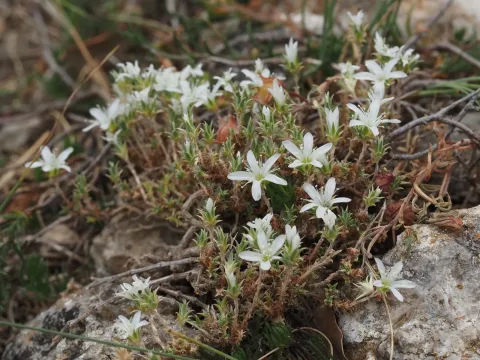
Arenaria aggregata
Arenaria aggregata
Arenaria aggregata belongs to the Caryophyllaceae family and is recognized as a hardy, low-growing perennial. It is highly valued in gardening for its ability to form dense, cushion-like mats that resemble alpine flora.
What the section contains
Arenaria aggregata
Seeds should be sown in early spring or autumn. Since the seeds are extremely small, they should be surface-sown on a well-draining, gritty seed-starting mix and barely pressed into the substrate to ensure light contact.
Maintaining a consistent, light moisture level is crucial during germination. A cold frame or greenhouse environment usually provides the best results for seed propagation by protecting young seedlings from heavy rains.
Once seedlings have developed their first true leaves, they can be transplanted into small pots. It is essential to ensure that the potting medium remains mineral-rich and porous to support healthy root development.
Final planting into the garden should occur after the risk of hard frost has passed. Spacing plants about 20 cm apart allows for proper airflow, which is critical for maintaining the plant's structural integrity.
The species originates from limestone-rich, mountainous regions of Europe. Consequently, it thrives in environments that mimic these natural conditions, particularly in rocky crevices or scree garden beds.
Full sun is a non-negotiable requirement for Arenaria aggregata. In shade or partial shade, the plant quickly loses its compact habit, becoming leggy and significantly more prone to fungal infections.
Soil drainage is the most important factor for success. The plant prefers sandy, stony, or gravelly soil profiles that do not retain excess water, ensuring the root zone stays aerated even during wet months.
A neutral to slightly alkaline soil pH is ideal. If the soil is naturally acidic, it is advisable to incorporate crushed limestone or lime to improve growth rates and ensure the plant’s longevity.
The plant is naturally drought-tolerant once established. Supplemental irrigation is only necessary during extreme heatwaves, and even then, water should be applied at the base rather than over the foliage.
Fungal issues, specifically root rot, pose the greatest threat to this plant. This is almost always caused by poor soil drainage or excessive moisture remaining in the crown of the plant for too long.
Powdery mildew can occur if the airflow around the cushion is insufficient. Planting in open, breezy locations and avoiding crowding are the best cultural methods for preventing this disease.
Aphids occasionally target young, succulent growth in the spring. While they rarely kill the plant, they can weaken its overall vigor, making it more susceptible to other stressors like environmental fluctuations.
Over-fertilization is harmful to Arenaria aggregata, as it encourages soft growth that is more attractive to pests and less hardy during winter months. A lean, nutrient-poor soil is always preferred.
Preventative maintenance includes keeping the area around the plants free of decaying leaf litter, which can harbor moisture and promote rot throughout the winter season.