
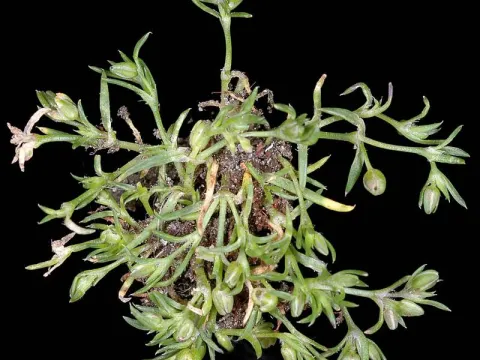
Annual pearlwort
Sagina apetala
Annual pearlwort (Sagina apetala) is a small herbaceous annual plant belonging to the Caryophyllaceae family. In an agricultural context, it is typically considered a weed that interferes with crop emergence and establishment.
What the section contains
Annual pearlwort
Originally native to temperate regions of Europe and Asia, the plant has become a naturalized cosmopolitan species, thriving in various environments ranging from sandy fields to compact garden soils.
Botanically, the species is characterized by its slender, often tufted stems and needle-like leaves. Its defining feature is the absence or high reduction of petals in its small, inconspicuous flowers, facilitating self-pollination.
It prefers moist, open, and often disturbed habitats. In fields, it frequently exploits gaps in crop stands, thriving in areas where soil compaction hinders the growth of more competitive plants.
Despite its small size, annual pearlwort can become problematic in intensive agriculture by occupying space that would otherwise be used by germinating crop seeds.
Management of this weed relies heavily on mechanical cultivation. Since the plant has a shallow root system, surface tillage is highly effective at killing seedlings before they reach maturity.
In cases of heavy infestation, post-emergence herbicide applications are utilized. However, efficacy depends on applying the treatment while the weeds are in the young rosette stage.
Cultural practices such as maintaining vigorous crop stands prevent the establishment of pearlwort by outcompeting it for light and nutrient resources throughout the growing season.
The plant demonstrates significant tolerance to environmental stress, and there are few known major pathogens or specialized pests that significantly affect its population dynamics.
The primary strategy against Sagina apetala remains prevention through field sanitation and ensuring crop density is optimized to minimize open soil patches.