
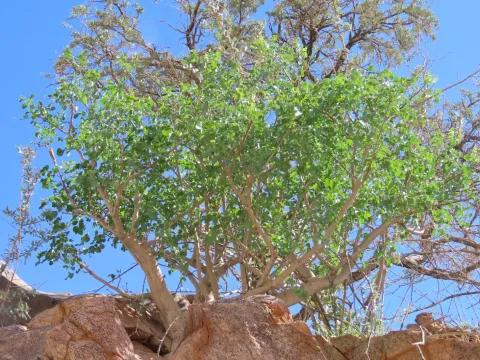
Commiphora saxicola
Commiphora saxicola
Propagation of Commiphora saxicola is primarily achieved through seeds or stem cuttings. Seed germination requires high temperatures, ideally maintained between 25 and 28 degrees Celsius, to simulate its natural habitat.
What the section contains
Commiphora saxicola
The growing medium must be highly porous, consisting of coarse sand, perlite, or volcanic rock mixed with a minimal amount of organic substrate. Proper drainage is the most critical factor for young seedlings.
When sowing, seeds should be placed at a depth of less than one centimeter. Consistent, light moisture is required initially, but the surface should be allowed to dry out between watering sessions to prevent damping-off disease.
Stem cuttings represent an alternative method, though it requires careful management. Cuttings must be allowed to callus for several days before planting to ensure they do not rot when introduced to the medium.
Rooting hormone may be applied to the callused end to stimulate growth. Once planted, the cuttings should be kept in a bright, warm location, away from direct midday sunlight, until roots are established.
As a member of the Burseraceae family, Commiphora saxicola is a true xerophyte, perfectly adapted to arid, rocky landscapes. It requires maximum sunlight exposure throughout the day to maintain its compact, sturdy growth habit.
Soil requirements are straightforward: the plant thrives in poor, fast-draining, neutral to slightly alkaline soil. Rich or heavy soils are detrimental and will quickly lead to root degradation.
Watering should be strictly regulated. The plant enters a dormant phase during cooler months, during which watering should be almost completely withheld. Overwatering is the single most common cause of death for this species.
Temperature range should remain between 22 and 30 degrees Celsius during the active growing season. The plant exhibits high heat tolerance but may struggle if temperatures drop consistently below 15 degrees Celsius.
Air circulation is vital for this species, especially in indoor collections or greenhouses. Sufficient airflow prevents the accumulation of excess humidity and minimizes the risk of fungal infections around the stems.
The practical application of this species is largely decorative, focusing on its appeal for succulent and caudiciform enthusiasts. Pruning and shaping are the main cultural interventions carried out by growers.
Formative pruning should be conducted at the very start of the growing season. This ensures that the plant recovers quickly and produces new, healthy shoots that maintain its characteristic architectural form.
Seed harvesting is limited to mature, established specimens. Fruits should be allowed to dry completely on the branches before collection to ensure the seeds have reached full maturity and viability.
The aromatic resin produced by the plant is a natural byproduct of its biological processes. While historically significant for the genus, in agricultural practice, it is not harvested unless part of specific research.
Proper storage of seeds is essential, requiring a cool, dry, and dark environment. If stored correctly, seeds remain viable for several months, though their germination rate naturally declines over time.
Fungal pathogens associated with overwatering are the primary threat to Commiphora saxicola. Root rot develops silently and is often fatal before symptoms become visible on the above-ground parts of the plant.
Spider mites are a common pest in indoor environments where the air is dry. They create fine webs and sap the vitality of the plant, often leading to yellowing of the leaves and premature shedding.
Scale insects can attach themselves to the stems and branches. These pests are difficult to remove due to their protective coverings and require systemic insecticides or careful manual cleaning with alcohol-based solutions.
Light deprivation often manifests as elongated, weak stems that lack the plant’s natural structural integrity. This condition also makes the specimen more susceptible to opportunistic infections and pests.
- Root rot due to poor drainage
- Spider mite infestations
- Scale insect presence
- Mealybugs in foliage crevices
- Physiological weakness from low light