
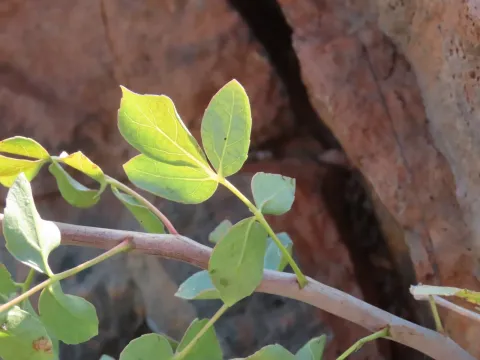
Commiphora tenuipetiolata
Commiphora tenuipetiolata
Commiphora tenuipetiolata belongs to the Burseraceae family. This shrub or small tree is indigenous to the arid landscapes of Southern Africa, thriving in rocky and harsh environments.
What the section contains
Commiphora tenuipetiolata
The plant requires extremely well-draining soil to mimic its natural habitat. It is highly susceptible to root rot if waterlogged, making soil composition a critical factor in any cultivation project.
It exhibits strong drought tolerance, having evolved to store moisture and survive extreme temperatures reaching well above 30 degrees Celsius during the peak of the dry season.
Full sun exposure is mandatory for healthy development. The plant does not perform well in shade, as its biological cycles depend on high light intensity to drive photosynthesis and resin production.
Management practices prioritize minimal water application and protecting the root zone from extreme cold. Propagation is typically achieved via seeds or stem cuttings conducted during warmer months.
The primary economic output of Commiphora tenuipetiolata is its aromatic resin. Harvesting is conducted through controlled tapping of the bark, which triggers the tree to release its natural sap.
Once exposed to air, the resin slowly hardens into solid nodules. This harvesting method has been practiced for generations to ensure the sustainability of the tree populations.
The resin is highly valued in the pharmaceutical and fragrance industries for its complex aromatic profile and recognized medicinal properties, including antiseptic and anti-inflammatory uses.
Efficiency in harvesting is maintained by alternating tapping sites on the trunk, allowing the plant time to heal and regenerate its secretory tissues before the next collection cycle.
Quality control during post-harvest processing involves removing bark debris and sorting the resin based on purity, which is essential for meeting international export standards for botanical extracts.