
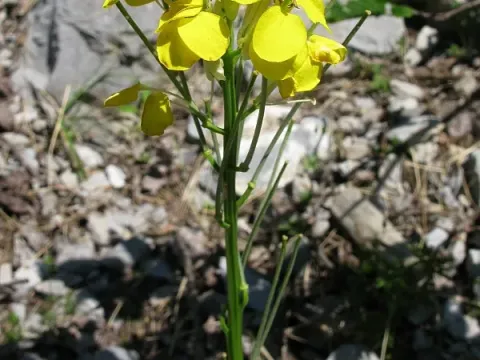
Berna wallflower
Erysimum burnatii
Erysimum burnatii is a plant species from the Brassicaceae family, often cultivated for its potential in pharmacological applications. Sowing should ideally be carried out in late autumn or early spring when the soil temperature begins to rise.
What the section contains
Berna wallflower
Due to the small size of the seeds, they should be planted at a shallow depth of approximately 1 to 2 centimeters to ensure successful germination and emergence through the soil surface.
Uniform spacing between rows, typically 30–45 centimeters, is essential to provide adequate ventilation and access for mechanical weeding during the early stages of plant growth.
In the first year, the crop establishes a basal rosette of leaves, which is crucial for the development of stems and flowers in the second year of its life cycle.
Ensuring adequate soil moisture during the germination period is critical; lack of water can lead to sparse plant populations and reduced overall yields.
This crop thrives in sunny locations as it is highly photophilous. Full sun exposure is necessary to maintain the concentration of active chemical compounds within the leaves and stems.
The soil should be well-drained and neutral in terms of pH level. Sandy loam or loam soils provide the best environment for root expansion and nutrient uptake.
Erysimum burnatii is known for its cold hardiness, allowing it to survive winter conditions effectively if the soil is properly prepared and free from excessive winter moisture.
Maintenance involves regular cultivation between rows to eliminate weeds and improve soil aeration, which significantly promotes robust plant growth.
Balanced fertilization, particularly with phosphorus and potassium, helps in root development and increases the plant's resistance to environmental stress factors.
The yield of Erysimum burnatii is strongly influenced by the quality of agricultural management. Under optimal conditions, the aerial biomass production reaches 1.5 to 2.0 tonnes per hectare.
Harvesting should be timed precisely with the peak flowering phase, which is when the concentration of heart-active glycosides is highest in the plant tissue.
Post-harvest processing requires rapid drying of the green mass. Using forced-air ventilation or shade-drying methods helps preserve the chemical integrity of the harvested material.
The stability of the yield also depends on the density of the planting; excessive density can lead to smaller plants, while low density may reduce the efficiency of the field use.
Proper seed collection allows for the regeneration of the crop in subsequent years, supporting sustainable production cycles on the farm.
Pests from the cruciferous family, particularly flea beetles, pose the most significant threat to young seedlings and can cause severe defoliation if left untreated.
Fungal diseases, such as powdery mildew, may occur during seasons with high humidity or poor field drainage, necessitating the implementation of preventive crop rotation.
Integrated pest management strategies are recommended, focusing on early identification and mechanical control rather than heavy reliance on chemical pesticides.
Weed management is vital during the initial growing phase; keeping the area clear allows the young plants to compete effectively for sunlight and nutrients.
Regular scouting of the fields is essential to detect the presence of pests and diseases before they reach thresholds that could compromise the entire crop.
Harvesting is typically done using mechanical cutters during the full flowering stage. The plants are cut at a height of 5–10 centimeters to facilitate regrowth.
The harvested biomass must be transported quickly to the drying facility to prevent self-heating, which can quickly degrade the quality of the raw material.
Drying is a critical step that must be controlled; the material is spread in thin layers in well-ventilated sheds until the stems are crisp and moisture levels are low.
Once dried, the material should be checked for moisture content to ensure it does not mold during storage, preserving the shelf life of the botanical product.
Final storage involves placing the dried product in protective packaging in a cool, dry place away from direct sunlight to maintain its active constituents.