
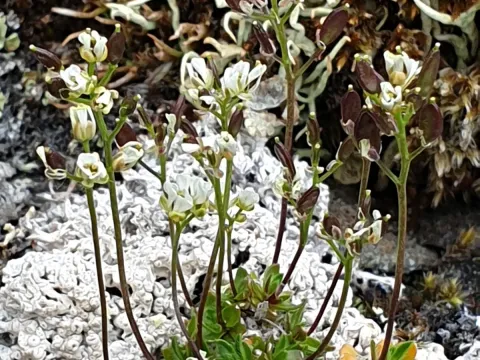
Fladniz's Whitlow-grass
Draba fladnizensis
Fladniz's Whitlow-grass (Draba fladnizensis) is a member of the Brassicaceae family. It is a perennial herb that thrives in harsh, cold-climate environments, serving as a key indicator of arctic-alpine flora stability.
What the section contains
Fladniz's Whitlow-grass
The plant's natural range spans the circumpolar arctic regions and various high mountain systems across Eurasia and North America. It is typically found in rocky crevices, scree slopes, and tundra environments where other vegetation struggles to survive.
Botanically, it forms small, compact tufts or cushions, which is a structural adaptation to protect against biting winds and freezing temperatures. The leaves are arranged in a basal rosette, and the stems are often pubescent, which helps manage water retention.
Soil requirements focus on drainage and mineral composition rather than organic richness. The plant demands well-aerated, rocky substrates that mimic its native alpine environment, as stagnant moisture is detrimental to its long-term survival.
In terms of usage, this plant is not a commercial crop but serves as a biological model for studying cold tolerance and glacial survival strategies. Its preservation is significant for understanding the evolutionary history of arctic plant communities.
The primary threat to the species is the shift in climate patterns, which allows more aggressive vegetation to colonize traditional arctic niches. This competitive exclusion is a significant factor in the habitat reduction of Draba fladnizensis.
Cultivation risks include root rot and fungal infections triggered by excessive soil humidity or poor airflow. Maintaining a sterile, mineral-heavy substrate is essential for preventing these issues in botanical gardens or specialized nurseries.
Pests typical of the Brassicaceae family, such as flea beetles, can present challenges if the plant is grown outside its naturally extreme cold climate. Integrated pest management should prioritize physical barriers over chemical treatments.
Physical disturbance of the fragile cushions causes long-term damage, as the species has an exceptionally slow growth rate. Recovery from mechanical impact is hindered by the extremely short growing seasons inherent to its habitat.
Invasive non-native species pose a secondary threat by altering the nutrient cycle of the soil, which can be fatal for a plant evolved to survive in extreme oligotrophic conditions.