
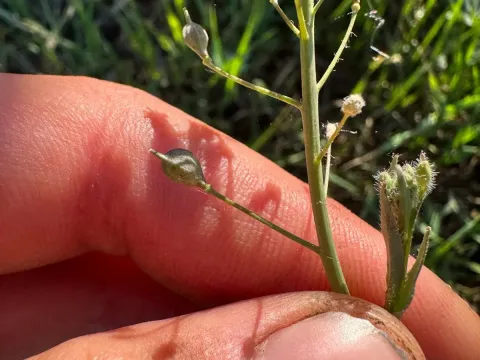
False flax
Camelina microcarpa
Camelina microcarpa, commonly known as False flax, is a member of the Brassicaceae family. It is an annual plant recognized for its adaptability and short growth cycle.
What the section contains
False flax
Sowing should take place as early as possible in the spring, once soil conditions are suitable for planting, allowing the crop to establish itself before summer drought.
The plant is highly frost-tolerant, meaning it can withstand cold spring temperatures and light frosts without suffering significant damage to its vegetative growth.
Seed depth is critical for successful germination and should be maintained at 1 to 2 centimeters to ensure the seeds have adequate moisture while still being able to emerge.
A typical seeding rate ranges from 6 to 10 million viable seeds per hectare, adjusted based on soil quality, expected moisture levels, and local environmental factors.
False flax is exceptionally resilient regarding soil conditions and can perform well on diverse soil types, including sandy, loamy, and even less fertile land.
The crop is highly valued for its drought tolerance, making it an excellent choice for regions that experience irregular rainfall or dry climatic conditions during the growing season.
Soil pH preference for this crop is broad, though it shows peak performance on neutral to slightly alkaline soils with good drainage properties.
As a sun-loving plant, it requires full exposure to sunlight throughout the day to ensure optimal photosynthesis and proper development of its flowering stalks.
Minimal fertilization is often required, as the crop is efficient at nutrient uptake, although adding balanced nitrogen and phosphorus can enhance overall yield.
The seed yield for Camelina microcarpa generally falls between 1,0 and 1,8 metric tons per hectare, depending heavily on annual precipitation and field management.
The seeds have a significant oil content, often reaching 30 to 40 percent, making them a high-quality raw material for producing specialty oils and biofuels.
Maximizing yield depends on maintaining the correct plant density to prevent excessive competition for nutrients and water, which could lead to stunted development.
Consistency in performance across different years makes it an attractive low-input crop for farmers who want to reduce overhead costs while diversifying their production.
Effective weed suppression is essential during the early stages of growth, as the crop can struggle to compete against aggressive weeds before its canopy closes.
Cruciferous flea beetles are the most significant pest threat, particularly during the seedling phase when the plant is most vulnerable to heavy foliage damage.
Pathogenic threats include downy mildew and alternaria leaf spot, which are more likely to appear in fields with poor ventilation or high humidity levels.
Insect management relies on early monitoring and the timely application of approved insecticides if pest populations exceed established economic thresholds.
Practicing crop rotation is the most effective biological strategy to prevent the buildup of soil-borne diseases and specific pests associated with the Brassicaceae family.
- Regular field scouting
- Seed treatment with fungicides
- Crop rotation with cereals
- Integrated pest management practices
- Control of volunteer host plants
Harvesting is typically performed via direct combining when the plants reach full maturity, indicated by the drying of the stems and the darkening of the pods.
Timing the harvest is critical; delaying it can lead to shattering and the loss of seeds on the ground, which drastically reduces the total harvested volume.
Adjusting the combine harvester settings is important to avoid seed damage; the threshing speed should be gentle to keep the seeds whole and maintain quality.
Pre-harvest desiccation is a common practice used to ensure a uniform maturation across the field, allowing for a more efficient and cleaner harvest process.
Post-harvest handling requires immediate cleaning to remove plant debris, followed by drying to a moisture level of about 8 percent for long-term, stable storage.