
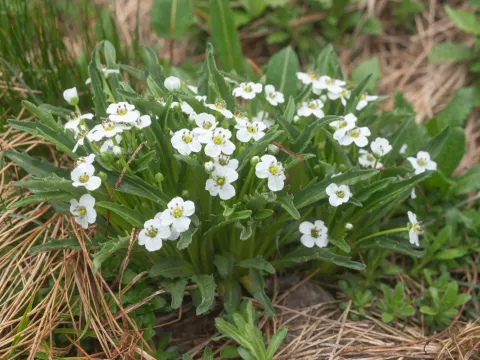
Thellungiella
Thellungiella
Sowing of Thellungiella salsuginea is typically performed in early spring when soil temperatures reach 10–12°C, ensuring a successful germination start.
What the section contains

Thellungiella
Due to its short life cycle, the crop is well-suited for early-season planting, taking advantage of residual winter soil moisture for rapid establishment.
For scientific or agricultural research, seeds are sown into light, well-draining substrates to simulate the harsh natural soil conditions the plant prefers.
Field density must be carefully managed to avoid overcrowding, as excessive competition between plants can lead to uneven development of the leaf rosette.
The seeds should be sown at a shallow depth of approximately 0.5–1 cm, as they require proximity to the surface to emerge effectively without exhaustion.
Thellungiella is a member of the Brassicaceae family, closely related to Arabidopsis thaliana, and serves as a model for studying salt stress tolerance in plants.
Native to Central Asia, Siberia, and parts of Canada, the plant has evolved to thrive in alkaline, saline, and nutrient-poor soil conditions where others fail.
It possesses an extraordinary capacity to accumulate salt within its tissues, maintaining cellular functions even under extreme soil salinity concentrations.
The crop demands high light intensity to maximize its metabolic efficiency, while also exhibiting resilience to significant temperature fluctuations during the season.
Soil management should prioritize good drainage, as the plant's root system is susceptible to damage from prolonged waterlogging in heavy or compacted soils.
The main pests affecting the crop include flea beetles (Phyllotreta species), which can cause significant damage to young seedlings if not controlled early.
High humidity levels increase the risk of fungal infections, such as powdery mildew, which can compromise the structural integrity of the plant foliage.
Integrated pest management strategies are recommended, focusing on early monitoring and the use of mechanical barriers to protect the initial growth phase.
Weed pressure remains a significant threat, as the plant lacks a rapid canopy closure during early development, making it vulnerable to invasive weeds.
Preventive agricultural practices, such as proper crop rotation and soil sanitation, are essential to minimize the buildup of soil-borne pathogens over time.
Harvesting of Thellungiella is initiated once the pods turn a yellowish-brown color, indicating physiological maturity and the final stage of seed development.
Timing is critical, as over-ripening leads to the natural shattering of pods, resulting in substantial seed loss if the harvest is delayed for even a few days.
The pods are usually gathered manually or via light mechanized cutting and then air-dried in covered facilities to ensure uniform moisture content.
Seed cleaning and sorting are performed using air-screen cleaners designed for small seeds, which effectively remove chaff and fine plant debris.
For long-term viability, stored seeds should be kept in airtight containers within a cool, dry environment to maintain high germination rates for future cycles.