
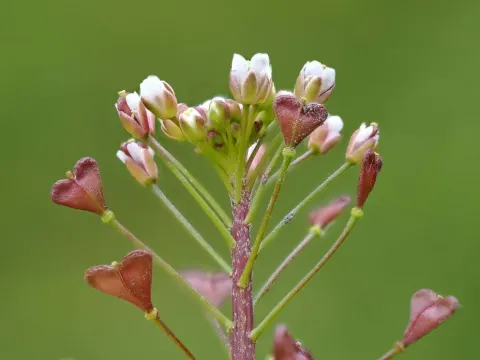
Red shepherd's purse
Capsella rubella
Red shepherd's purse (Capsella rubella) is an annual herbaceous plant belonging to the Brassicaceae family. Its biological cycle is characterized by rapid development, allowing it to quickly colonize disturbed soil surfaces.
What the section contains
Red shepherd's purse
Germination typically occurs in early spring, as the species thrives in cool, moist conditions. Seeds can germinate across a wide temperature range, often starting as soon as the soil thaws, providing the plant with a competitive edge.
The species demonstrates high seed production efficiency, with a single plant capable of shedding thousands of seeds annually. This prolific reproductive strategy ensures the long-term survival of the species in various agro-ecosystems.
Seed bank longevity is a key concern for farmers, as the seeds of Capsella rubella can remain viable in the soil for multiple years. This necessitates consistent monitoring throughout the cropping season.
In modern agricultural practices, controlling this plant during the early seedling stage is crucial for preventing widespread infestation across larger field areas and protecting the yield of main crops.
This species is highly adaptable to a variety of soil textures, including sandy, loamy, and clay soils. It shows a preference for nutrient-rich substrates, which often leads to increased growth rates in heavily fertilized agricultural fields.
Regarding moisture requirements, the plant is moderately demanding. It maintains physiological activity under moderate drought but prefers consistent soil moisture, which promotes robust rosette formation and rapid flower stalk elongation.
Sunlight exposure is essential for the optimal development of Capsella rubella. While it can survive in partial shade, its competitive ability is significantly enhanced in open, well-lit environments, particularly in cereal and legume fields.
The plant demonstrates a high tolerance to varying pH levels, although neutral to slightly alkaline conditions are often associated with the most vigorous growth patterns.
Integrated weed management remains the most effective strategy for controlling this species. This includes crop rotation, timely tillage, and the strategic application of herbicides to reduce the seed bank density.
Capsella rubella acts as a host plant for numerous insect pests, particularly those that target brassica crops. This includes flea beetles, which utilize the weed as an initial food source early in the growing season.
The plant is also a known vector for various phytopathogens, including viruses and fungal pathogens that affect commercial crops. Its presence in field borders can significantly increase the disease pressure on adjacent harvests.
Root-knot nematodes and other soil-borne pests often utilize the root systems of the red shepherd's purse to survive during periods when the primary host crop is absent from the field.
Effective management requires removing the plants before they reach the seed-setting phase. If seed dispersal occurs, the potential for rapid infestation in subsequent seasons increases exponentially.
Agricultural consultants recommend regular phytosanitary inspections of field margins and fallow lands to prevent the spread of Capsella rubella into productive arable areas, thereby reducing the need for intensive chemical applications.