
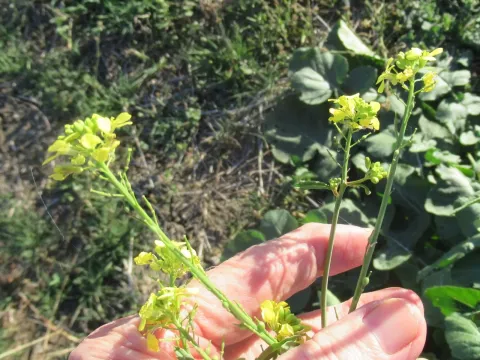
Rapistrum
Rapistrum
Rapistrum is a resilient member of the Brassicaceae family often managed as a spontaneous crop. For controlled sowing, it is advisable to plant seeds in early spring, as soon as the soil temperatures consistently exceed 6 degrees Celsius to ensure uniform emergence.
What the section contains

Rapistrum
The seeds are relatively small, requiring a shallow sowing depth of about 1 to 2 centimeters. This shallow placement allows for rapid germination and root establishment, which is vital for the plant to compete effectively against other opportunistic species.
When used as a green manure or cover crop, higher seeding densities are recommended to maximize biomass production and provide adequate soil coverage. This helps in suppressing weeds and improving soil structure through the decay of organic matter.
In regions with mild winters, autumn sowing can be a viable strategy, allowing the plant to establish its rosette phase before the dormant period. This often leads to earlier blooming and more vigorous growth in the following spring season.
The row spacing should be adjusted based on the intended use; narrower spacing is ideal for soil protection, while wider rows facilitate mechanical weeding and nutrient application during the plant's active vegetative growth phase.
Rapistrum demonstrates exceptional adaptability to various climates, showing high tolerance to temperature extremes. It thrives in well-lit areas where solar radiation is abundant, as shade negatively impacts its overall metabolic processes and development.
The crop is not particularly demanding regarding soil quality and can grow successfully in various textures, from sandy loams to heavier clays. It exhibits notable tolerance to slightly saline conditions, which is a rare trait among many common cultivated crops.
Water requirements are moderate, with the plant relying on a deep taproot to access water in deeper soil profiles during dry spells. This makes it a reliable choice for areas with inconsistent rainfall patterns during the mid-summer months.
The ideal temperature for active growth ranges between 15 and 22 degrees Celsius. While it is hardy against light frosts during the vegetative stage, prolonged exposure to extreme heat can accelerate senescence and induce early flowering.
Balanced fertilization, particularly with nitrogen, is beneficial if the primary goal is maximizing biomass production. However, over-fertilization can lead to excessive stem growth, making the plants more susceptible to lodging under heavy winds.
The most significant threats to Rapistrum come from insects that target the Brassicaceae family, particularly flea beetles. These pests frequently damage the cotyledons and young leaves of seedlings, often necessitating protective measures early in the season.
During the reproductive phase, the pollen beetle poses a significant risk to yield, as it feeds on the floral parts, preventing successful pollination and seed set. Monitoring population levels during the bud formation stage is crucial for management.
Fungal diseases like downy mildew and powdery mildew can occur, especially in humid or poorly ventilated stands. These diseases can lead to chlorosis and reduced photosynthetic capacity, significantly weakening the plant's physiological health.
Clubroot, caused by soil-borne pathogens, can severely inhibit root development, leading to stunted plants and poor nutrient uptake. Rotating the crop with non-brassicaceous species is the primary strategy to prevent soil inoculum buildup.
- Flea beetles
- Pollen beetles
- Downy mildew
- Powdery mildew
- Clubroot