
Repanda cabbage
Brassica repanda
Brassica repanda is a herbaceous perennial plant species belonging to the Brassicaceae family. Unlike common agricultural crops, this species is primarily found in wild, rocky, and high-altitude habitats, serving as a model for studying extreme environmental tolerance.
What the section contains
Repanda cabbage
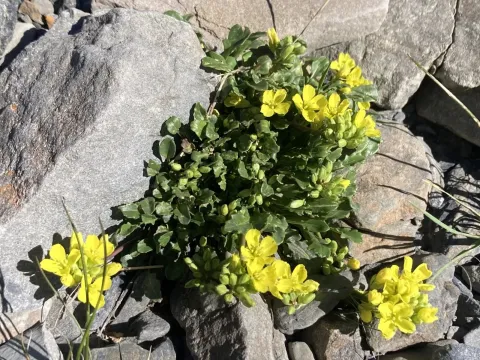
The morphology of the plant includes a basal rosette of leaves and a slender stem, which produces characteristic yellow cruciferous flowers. Its root system is deeply penetrating, allowing the plant to stabilize itself against loose substrates such as limestone scree found in its native mountain ranges.
This species is native to the mountain regions of Europe. It is specialized to survive in sites with very thin soil layers, where nutrient availability is low, but drainage is excellent. These conditions prevent the accumulation of moisture around the root collar, protecting the plant from rot.
Climate requirements for Brassica repanda center on high light intensity and exposure to cooling alpine breezes. It thrives in temperate, high-elevation zones where temperature fluctuations between day and night can be significant, triggering its natural physiological defensive mechanisms.
In terms of cultivation, the plant requires a specialized substrate consisting of a high percentage of gravel and coarse sand. It is highly intolerant of waterlogging, and standard irrigation methods used in commercial agriculture are generally unsuitable. Success depends on maintaining a sparse, nutrient-poor environment that mimics its natural habitat.