
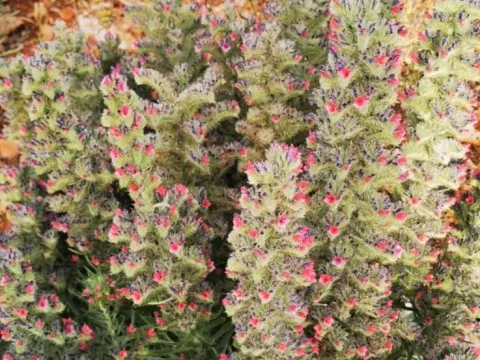
Echium albicans
Echium albicans
Echium albicans is a perennial species that requires specific preparation for successful establishment in both wild and cultivated settings.
What the section contains
Echium albicans
The optimal time for sowing is early spring when soil temperatures stabilize, or late autumn, which allows seeds to undergo natural winter stratification.
The seeds have a hard seed coat, so light scarification is highly recommended before planting to improve germination rates significantly.
Sowing depth should be shallow, approximately 1 to 2 centimeters, as the seeds need light exposure to break dormancy and sprout effectively.
It is important to manage plant density during sowing, as the species develops large basal rosettes that require space to mature properly.
This plant belongs to the Boraginaceae family and is highly regarded for its ability to thrive in challenging, impoverished soil conditions.
Echium albicans is noted for its exceptional drought tolerance, making it an ideal choice for restoring degraded land or establishing bee forage in arid zones.
The plant requires full sun exposure; it does not perform well in shaded areas, as low light intensity significantly hinders nectar production.
Well-drained soil, particularly calcareous or rocky substrates, is preferred to ensure the health of the taproot system and prevent winter rot.
In its native Mediterranean-type climate, the plant exhibits excellent resilience against high diurnal temperature swings and dry, windy conditions.
The primary economic value of Echium albicans lies in its superior nectar production, making it a cornerstone for high-quality honey production.
Bees actively visit the flowers throughout the blooming season, collecting both nectar and pollen to support rapid colony development.
Honey derived from this plant is highly prized for its light color, delicate floral aroma, and high glucose content, which delays crystallization.
Productivity levels depend heavily on plant population density and local climate conditions during the peak flowering window of the season.
Integrating this crop into local forage rotations can substantially increase the carrying capacity of the environment for honeybee populations.
Echium albicans possesses a strong natural defense system, including secondary metabolites that protect it from most generalist insect pests.
The most significant threat to the culture is weed competition during the establishment phase of the first year of growth.
Fungal issues, such as root rot, may occur if the soil remains waterlogged for extended periods, which is why proper drainage is critical.
Leaf-chewing insects rarely reach economic injury thresholds, allowing for a chemical-free management approach in most cultivated areas.
Proactive management of adjacent weed populations helps ensure the long-term vitality and dominance of the Echium stands.
Seed harvesting is challenging because the seeds ripen sequentially from the bottom to the top of the inflorescence, leading to potential loss.
The standard practice involves swathing the stalks into windrows once the lower seeds turn dark, allowing the remaining seeds to mature naturally.
Threshing should be performed under controlled conditions with low airflow settings to prevent the loss of light, mature seeds during cleaning.
After collection, seeds must be thoroughly dried in a well-ventilated area before long-term storage to prevent fungal contamination.
For nectar production purposes, the harvest phase involves the seasonal collection of honey from hives placed in or near the blooming fields.