
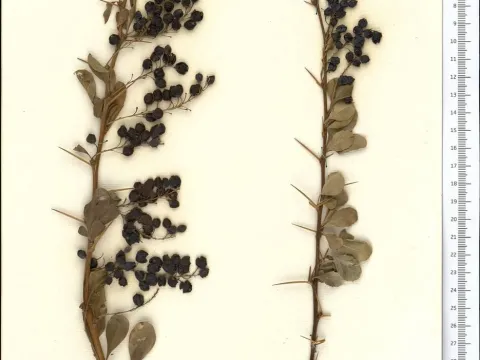
Berberis nummularia
Berberis nummularia
Propagation of Berberis nummularia is primarily achieved through seeds, which require stratification during winter months to ensure successful germination in the spring.
What the section contains
Berberis nummularia
Vegetative propagation via semi-hardwood cuttings is a preferred method for commercial nurseries to ensure genetic uniformity and preserve specific phenotypic traits.
Preparation of the soil includes clearing weeds and incorporating organic matter to improve structure, ensuring the site receives full solar radiation for optimal growth.
Spacing requirements involve planting individual specimens at least two meters apart to allow for proper airflow and to facilitate mechanical maintenance operations.
Immediately after planting, it is crucial to apply a layer of mulch to conserve soil moisture and suppress weed competition during the critical establishment phase.
Berberis nummularia, a member of the Berberidaceae family, is naturally adapted to arid and semi-arid environments, demonstrating high resilience to drought conditions.
The shrub thrives in well-drained, neutral to slightly alkaline soils. It is highly intolerant of waterlogging, which often leads to root rot and poor development.
Climatic requirements focus on a need for extended sunny periods and moderate winter temperatures. It is well-suited for cultivation in open, exposed landscapes.
Agricultural management includes systematic pruning to remove old or diseased wood and to maintain a productive, airy canopy structure for berry production.
Fertilization regimes should prioritize potassium and phosphorus to support flowering and berry maturation, applied during the early growth stages of spring.
The economic value of this species lies in its berries, which are harvested for culinary applications such as condiments, jellies, and traditional flavoring agents.
Yield capacity matures as the shrub reaches its third or fourth year, with production efficiency relying on the health of the canopy and availability of solar energy.
The fruits are known for their high organic acid and vitamin content, making them a valued resource for small-scale commercial fruit production and processing.
Beyond fruit production, the plant is valued for its potential in soil erosion control on sloped terrains due to its extensive and robust root architecture.
Sustainable harvesting and management ensure consistent annual yields, provided the plant is protected from severe temperature fluctuations and competitive weeds.
The primary threats to Berberis nummularia include various fungal pathogens that flourish in environments with poor air circulation or excessive humidity levels.
Aphid infestations represent the most significant pest risk, requiring careful monitoring of new growth during the spring to prevent stunted development.
Integrated pest management strategies are recommended, utilizing a combination of biological controls and selective chemical applications only when thresholds are exceeded.
Powdery mildew may occur on foliage, particularly in areas with dense planting schemes; therefore, maintaining proper canopy density is a vital cultural control.
Continuous monitoring and early detection of phytosanitary issues are essential to maintaining a productive plantation and preventing widespread crop loss.
Harvesting is labor-intensive because the plant possesses sharp thorns on its branches, necessitating the use of heavy-duty gloves and specialized harvesting tools.
The berries should be collected at peak maturity, identifiable by their uniform color, to ensure the optimal balance of flavor and chemical composition.
Post-harvest management involves immediate cooling or processing to maintain fruit quality, as fresh berries are highly perishable under ambient conditions.
Drying is a common processing method for long-term storage, which preserves the antioxidants and nutritional value for various culinary and herbal uses.
Proper sorting post-harvest is required to remove impurities such as leaves and branches, ensuring a high-quality final product for market delivery.