
Olearia
Olearia
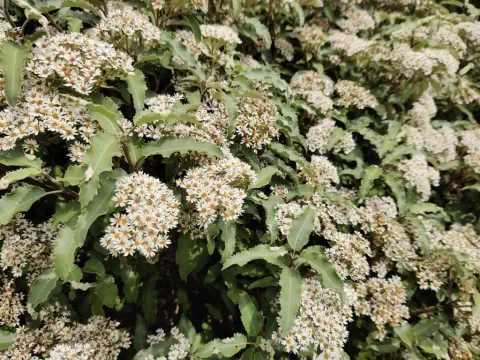
Olearia is a diverse genus of evergreen shrubs and small trees belonging to the Asteraceae family. Known commonly as the daisy bush, these plants are celebrated for their prolific, daisy-like flowers that bloom in abundance, often covering the entire shrub.
What the section contains
 Holly-leaved daisy bush
Olearia ilicifolia Hook. f.
Holly-leaved daisy bush
Olearia ilicifolia Hook. f.
 Holly-leaved olearia
Olearia macrodonta Baker
Holly-leaved olearia
Olearia macrodonta Baker
 Musk daisy bush
Olearia moschata Hook. f.
Musk daisy bush
Olearia moschata Hook. f.
 Olearia albida
 (Hook. f.) Hook. f.
Olearia albida
Olearia albida (Hook. f.) Hook. f.
 Olearia avicenniifolia
 (Raoul) Hook. f.
Olearia avicenniifolia
Olearia avicenniifolia (Raoul) Hook. f.
 Olearia axillaris
 (DC.) Benth.
Olearia axillaris
Olearia axillaris (DC.) Benth.
 Olearia haastii
Olearia x haastii Hook. f.
Olearia haastii
Olearia x haastii Hook. f.
 Olearia nummulariifolia
 (Hook. f.) Hook. f.
Olearia nummulariifolia
Olearia nummulariifolia (Hook. f.) Hook. f.
 Olearia phlogopappa
 (Labill.) DC.
Olearia phlogopappa
Olearia phlogopappa (Labill.) DC.
 Olearia traversii
 (F. Muell.) Hook. f.
Olearia traversii
Olearia traversii (F. Muell.) Hook. f.
Olearia
Originating primarily from Australia, New Zealand, and New Guinea, Olearia species inhabit a wide range of environments, from coastal cliffs to alpine meadows. This geographical diversity has resulted in various species with different hardiness levels suited for diverse garden applications.
Successful cultivation requires a position in full sun, which is essential for healthy development and profuse flowering. While some species can tolerate partial shade, they perform best when exposed to sunlight for the majority of the day, protected from harsh, drying winds.
Soil requirements focus heavily on drainage; these plants detest "wet feet." A well-drained, slightly acidic to neutral soil profile is ideal. Incorporating coarse sand or fine gravel into the planting hole can significantly improve success rates in heavy clay soils.
Regular maintenance involves light pruning after flowering to encourage dense, bushy growth. This practice prevents the plant from becoming leggy and promotes a more uniform shape, which is highly desirable in both private gardens and commercial landscapes.
The primary threat to Olearia health is root rot caused by poor soil drainage and waterlogging. Symptoms include leaf yellowing and stem collapse, often appearing after heavy rain periods if the planting site does not have an efficient water escape mechanism.
Aphids are the most common insect pest, typically targeting the succulent new growth during the spring flush. Infestations can lead to distorted leaves and the presence of sooty mold, which grows on the honeydew secreted by the insects.
Spider mites can become a significant issue during hot and dry summer months. Their feeding activity causes stippling on the foliage, eventually leading to leaf drop. Regular misting and maintaining soil moisture can help deter these pests.
Powdery mildew may occur if the plants are placed in areas with poor airflow and high humidity. Ensuring adequate spacing between shrubs is the best preventive measure to maintain good air circulation throughout the canopy.
When managing these threats, integrated pest management (IPM) is recommended. This includes encouraging natural predators, practicing proper hygiene through the removal of dead plant material, and applying targeted organic treatments only when necessary.