
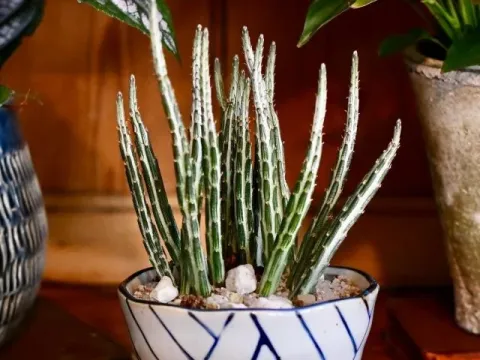
Kleinia
Kleinia
Kleinia is a genus of succulent plants belonging to the Asteraceae family. Long confused with the Senecio genus, Kleinia is now recognized as a distinct group, known for its unique, often drought-resistant succulent structures that store water efficiently.
What the section contains
 Kleinia aizoides
Kleinia aizoides
Kleinia aizoides
 Kleinia anteuphorbium
Kleinia anteuphorbium
Kleinia anteuphorbium
 Kleinia barbertonica
Kleinia barbertonica
Kleinia barbertonica
 Kleinia ficoides
Kleinia ficoides
Kleinia ficoides
 Kleinia grandiflora
Kleinia gregorii
Kleinia gregorii
Kleinia grandiflora
Kleinia grandiflora
Kleinia gregorii
Kleinia gregorii
 Kleinia isabellae
Kleinia lunulata
Kleinia lunulata
Kleinia isabellae
Kleinia isabellae
Kleinia lunulata
Kleinia lunulata
 Kleinia mandraliscae
Kleinia mandraliscae
Kleinia mandraliscae
 Kleinia neriifolia
Kleinia neriifolia
Kleinia neriifolia
 Kleinia repens
Kleinia repens
Kleinia repens
 Kleinia stapeliiformis
Kleinia stapeliiformis
Kleinia stapeliiformis
 Kleinia talinoides
Kleinia talinoides
Kleinia talinoides
Kleinia
These plants are native to the arid regions of Africa, the Canary Islands, and parts of India. They are well-adapted to harsh environments, thriving in rocky soils and areas with high sunlight intensity and minimal rainfall throughout the year.
For successful cultivation, Kleinia requires a bright, sunny location. Intense light is essential to prevent etiolation and to maintain the plant's characteristic compact, sculptural growth form. They are best suited for greenhouse environments or sunny windowsills.
The growing medium must be highly porous and inorganic. A mixture consisting of cactus potting soil, perlite, and coarse sand provides the necessary drainage. Poorly draining soil will quickly lead to root asphyxiation and subsequent decay.
Watering requirements follow a strict dry-cycle protocol. During the active growing season, provide thorough waterings, but only after the potting substrate has dried out completely. In winter, during the dormant phase, water should be restricted to prevent rotting.
The primary threat to Kleinia is root rot, triggered by overwatering or poor drainage. Once the roots are compromised, the stem may lose its turgidity, turning mushy and dark, which is a critical sign of advanced infection that often requires surgical excision.
Mealybugs are the most common pests found on Kleinia. These insects hide in the tight crevices of the stems or between leaves, feeding on plant sap. Early detection and manual removal using alcohol-dipped swabs can control minor infestations.
Spider mites can also attack the plant, particularly in hot, dry, and stagnant air conditions. Their presence is indicated by fine webbing and stippling on the skin of the plant, which reduces photosynthetic efficiency and lowers plant vigor.
Fungal pathogens may proliferate if the humidity levels are too high. To mitigate this, ensure adequate air circulation around the plants at all times, which helps keep the stems dry and reduces the chances of infection.
Maintenance and regular inspection are the best defenses. Removing old, dead leaves and checking the base of the stems regularly ensures that the plant remains healthy, while annual repotting allows for the renewal of exhausted substrate nutrients.