
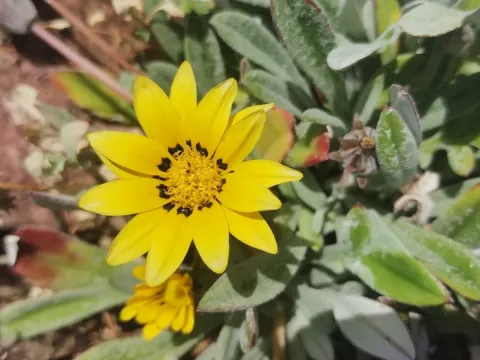
Gazania
Gazania Gaertn.
Gazania (Gazania Gaertn.) is a genus of flowering plants in the Asteraceae family. Known for their vibrant, daisy-like flowers, these plants are popular as annuals in cooler climates and short-lived perennials in warmer regions.
What the section contains
 Gazania hybrid
Gazania maritima Levyns x Gazania rigens (L.) Gaertn.
Gazania hybrid
Gazania maritima Levyns x Gazania rigens (L.) Gaertn.
 Gazania hybrida
Gazania krebsiana Less. x Gazania rigens (L.) Gaertn.
Gazania krebsiana
Gazania krebsiana Less.
Gazania krebsiana subsp. serrulata
Gazania krebsiana Less. subsp. serrulata (DC.) Roessler
Gazania hybrida
Gazania krebsiana Less. x Gazania rigens (L.) Gaertn.
Gazania krebsiana
Gazania krebsiana Less.
Gazania krebsiana subsp. serrulata
Gazania krebsiana Less. subsp. serrulata (DC.) Roessler
 Gazania linearis
 (Thunb.) Druce
Gazania longiscapa
Gazania longiscapa DC.
Gazania maritima
Gazania maritima Levyns
Gazania linearis
Gazania linearis (Thunb.) Druce
Gazania longiscapa
Gazania longiscapa DC.
Gazania maritima
Gazania maritima Levyns
 Gazania rigens
 (L.) Gaertn.
Gazania rigens
Gazania rigens leucolaena
Gazania rigens
Gazania rigens (L.) Gaertn.
Gazania rigens
Gazania rigens leucolaena
Gazania
Seeds should be sown indoors in February or March, approximately 8 to 10 weeks before the expected last frost. Use a well-draining, sterile seed-starting mix and maintain a temperature of about 20–22 °C for successful germination.
Once seedlings have developed two sets of true leaves, they should be transplanted into individual peat pots. Gazanias have deep taproots and are sensitive to root disturbance, so careful handling during transplanting is crucial.
Harden off the seedlings by gradually exposing them to outdoor conditions over the course of a week before planting them in the garden. Transplanting should occur only when the soil has fully warmed up in late spring.
For best results, space the plants about 20 to 30 cm apart. Adequate spacing allows for optimal air circulation, which is vital for preventing humidity-related issues once the plants reach maturity.
Gazanias are sun-loving plants that require full sun exposure to thrive. Their flowers are phototropic, meaning they open wide in bright sunlight and close tightly during cloudy weather or at night.
The soil must be light, sandy, and well-drained. These plants are native to Southern Africa and have evolved to survive in poor, rocky soils. They cannot tolerate heavy, waterlogged clay, which often leads to root rot.
These plants are highly drought-tolerant once established. Watering should be moderate; it is better to let the soil dry out significantly between waterings than to keep it constantly moist.
Fertilization is beneficial for sustained blooming. A balanced, water-soluble fertilizer applied every three to four weeks during the growing season will encourage continuous flower production.
Climate adaptation is key for Gazania. They perform best in hot, dry summers and are intolerant of high humidity or frost. Selecting a high, well-ventilated spot in the landscape ensures the plants remain healthy and vibrant.
Botrytis, or gray mold, is the most common fungal issue for Gazanias, typically occurring in environments with poor air circulation or excessive moisture. It manifests as a fuzzy gray growth on foliage and stems.
Root rot is another significant concern caused by overwatering or poorly drained soil. If a plant appears stunted or wilted despite moist soil, it is often an indicator that the root system is failing due to pathogen pressure.
Aphids and spider mites are the most frequent pests affecting Gazania. These pests colonize the undersides of leaves and stems, causing yellowing, leaf distortion, and a decline in the overall vigor of the plant.
Control strategies involve the use of insecticidal soaps, neem oil, or systemic insecticides. Regular inspection of the undersides of leaves is essential for early detection, preventing widespread infestation.
Maintaining a clean garden environment is vital for plant health. By removing weeds and debris from the base of the plants and ensuring proper spacing, growers can significantly reduce the risk of both pest outbreaks and fungal infections.