
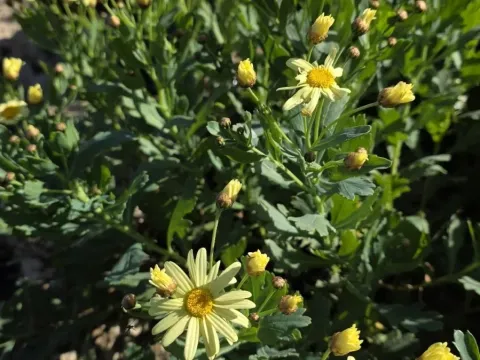
Argyranthemum
Argyranthemum
Argyranthemum is a genus of perennial herbaceous plants or subshrubs belonging to the Asteraceae family. In agricultural practice and landscaping, it is widely recognized as the "Marguerite daisy."
What the section contains
 Argyranthemum adauctum
Argyranthemum adauctum
Argyranthemum adauctum
 Argyranthemum dissectum
Argyranthemum dissectum
Argyranthemum dissectum
 Argyranthemum foeniculaceum
Argyranthemum foeniculaceum
Argyranthemum foeniculaceum
 Argyranthemum gracile
Argyranthemum gracile
Argyranthemum gracile
 Argyranthemum haematomma
Argyranthemum haematomma
Argyranthemum haematomma
 Argyranthemum hybrids
Argyranthemum hybrids
Argyranthemum hybrids
 Argyranthemum maderense
Argyranthemum maderense
Argyranthemum maderense
 Argyranthemum pinnatifidum
Argyranthemum pinnatifidum
Argyranthemum pinnatifidum
 Argyranthemum thalassophilum
Argyranthemum thalassophilum
Argyranthemum thalassophilum
 Argyranthemum webbii
Argyranthemum webbii
Argyranthemum webbii
Argyranthemum
The native range of this plant includes the Canary Islands and Madeira. In mild climates, it grows as an evergreen shrub, whereas in regions with cold winters, it is typically cultivated as an annual crop or a container-grown plant.
Successful cultivation of Argyranthemum requires well-drained, fertile loamy soils with a neutral to slightly acidic pH level. The plant has high light requirements and prefers open, sunny locations protected from strong winds.
The optimal temperature range for development is between +18 and +24 degrees Celsius. The plant is sensitive to severe frost, so when grown in open fields in northern latitudes, it should be planted only after the threat of late spring frosts has passed.
Agronomic management includes regular watering without waterlogging the roots, as well as the application of balanced mineral fertilizers during the active vegetative growth phase. Timely pruning of shoots helps maintain a compact shrub form and stimulates profuse flowering.
The main pests affecting the crop include aphids, spider mites, and whiteflies, which frequently attack young shoots and the undersides of leaves, especially in low-humidity conditions.
Common fungal diseases that threaten the crop are powdery mildew, gray mold (Botrytis), and fusarium wilt. These typically occur when there is excessive humidity and poor air circulation in dense plantings.
To prevent these threats, it is necessary to implement crop rotation, manage plant spacing, and ensure optimal aeration in both greenhouse and open-field settings.
If pest infestation is detected, systemic insecticides should be applied, while fungal infections require the use of broad-spectrum fungicides.
Crucial protection measures include the disinfection of planting tools and maintaining clean soil conditions to prevent the accumulation of pathogens that persist in plant debris after the growing season.