
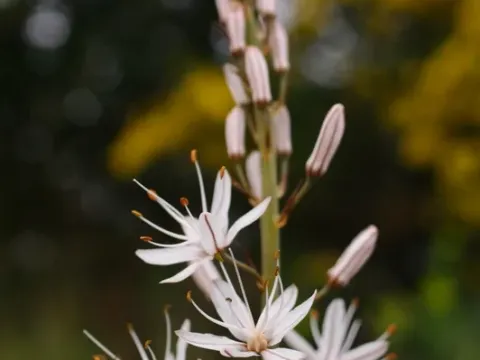
Summer Asphodel
Asphodelus aestivus
Sowing Summer Asphodel seeds is most successful when performed in late autumn, allowing for a natural stratification period over the winter months. This mimics the plant's native ecological cycle and ensures a more uniform germination rate in the following spring.
What the section contains
Summer Asphodel
For container-based cultivation, use a well-draining substrate composed of sand and loam. Seeds should be sown at a depth of approximately 1.5 cm and kept in a cool, bright location until sprouts appear, after which they can be transitioned to full sunlight.
Vegetative propagation is achieved by carefully dividing the fleshy rhizomes during the dormant season. It is vital to ensure that each divided section contains at least one active growth point to guarantee the establishment of a robust new plant.
When transplanting young seedlings into the field, ensure that the crown of the plant is positioned level with the soil surface. Improper planting depth can lead to crown rot or suppressed growth, especially if the soil is too heavy or waterlogged.
Spacing is a critical agronomic factor; maintaining a distance of at least 40 cm between plants prevents overcrowding. Proper spacing facilitates the essential air circulation needed to mitigate the risk of fungal pathogens in the humid early summer months.
Summer Asphodel is a classic xerophyte, thriving in open, sun-drenched environments with minimal competition. It requires full sun exposure for the majority of the day to produce its characteristic flower spikes and maintain foliage health.
The ideal soil profile for this species is porous, sandy, or rocky, providing excellent drainage. While the plant can tolerate nutrient-poor soils, it struggles significantly in heavy clay or soils with high organic matter content that retain excess moisture.
Water requirements are minimal; once established, the plant is highly drought-tolerant. Irrigation should be restricted strictly to periods of extreme drought, as the fleshy roots are highly susceptible to rot when subjected to persistent moisture.
Temperature management involves ensuring the plant is protected from severe frost if planted in non-native latitudes. In its natural Mediterranean-like climate, it adapts well to high heat, entering a state of dormancy during the peak of the dry summer season.
Minimal fertilization is required for this species. If necessary, a small application of a low-nitrogen, high-potash fertilizer in early spring can encourage stronger root development, which is vital for the plant's long-term survival in arid conditions.
The most pervasive threat to Asphodelus aestivus is root and crown rot, primarily induced by poor drainage. These fungal infections are often fatal and are most common in regions with high spring rainfall or poorly managed irrigation practices.
Powdery mildew may manifest on the foliage during periods of stagnant, humid weather. Management involves improving ventilation, spacing plants adequately, and applying sulfur-based fungicides if the infection threatens the plant's vigor.
Soil-dwelling larvae, particularly wireworms, can cause structural damage to the rhizomes. Agronomic control includes crop rotation and the mechanical disturbance of the soil during the early spring to disrupt the life cycle of these pests.
Aphids can occasionally colonize the flowering stalks during the reproductive phase. While rarely causing permanent damage, heavy infestations can weaken the plant and are best treated with mild insecticidal soaps or neem oil solutions.
Slugs and snails may present a risk to juvenile plants during cool, wet springs. Implementing physical barriers such as copper tape or crushed eggshells around the base of the plant effectively discourages these mollusks from reaching the foliage.